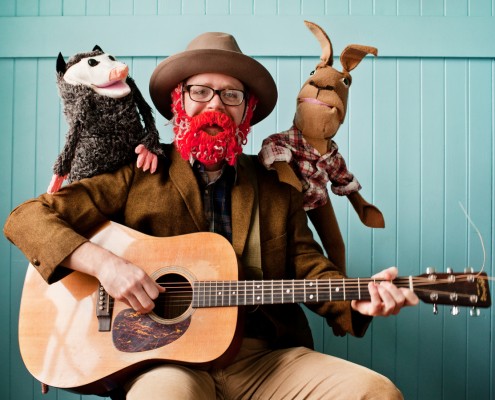
Interview: Brian Gorman of Rainbow Beast and Rock Band Land

RBL2-940x767

“..When you’re creating something, if you are able to embrace the magic in it, you end up making better art.”
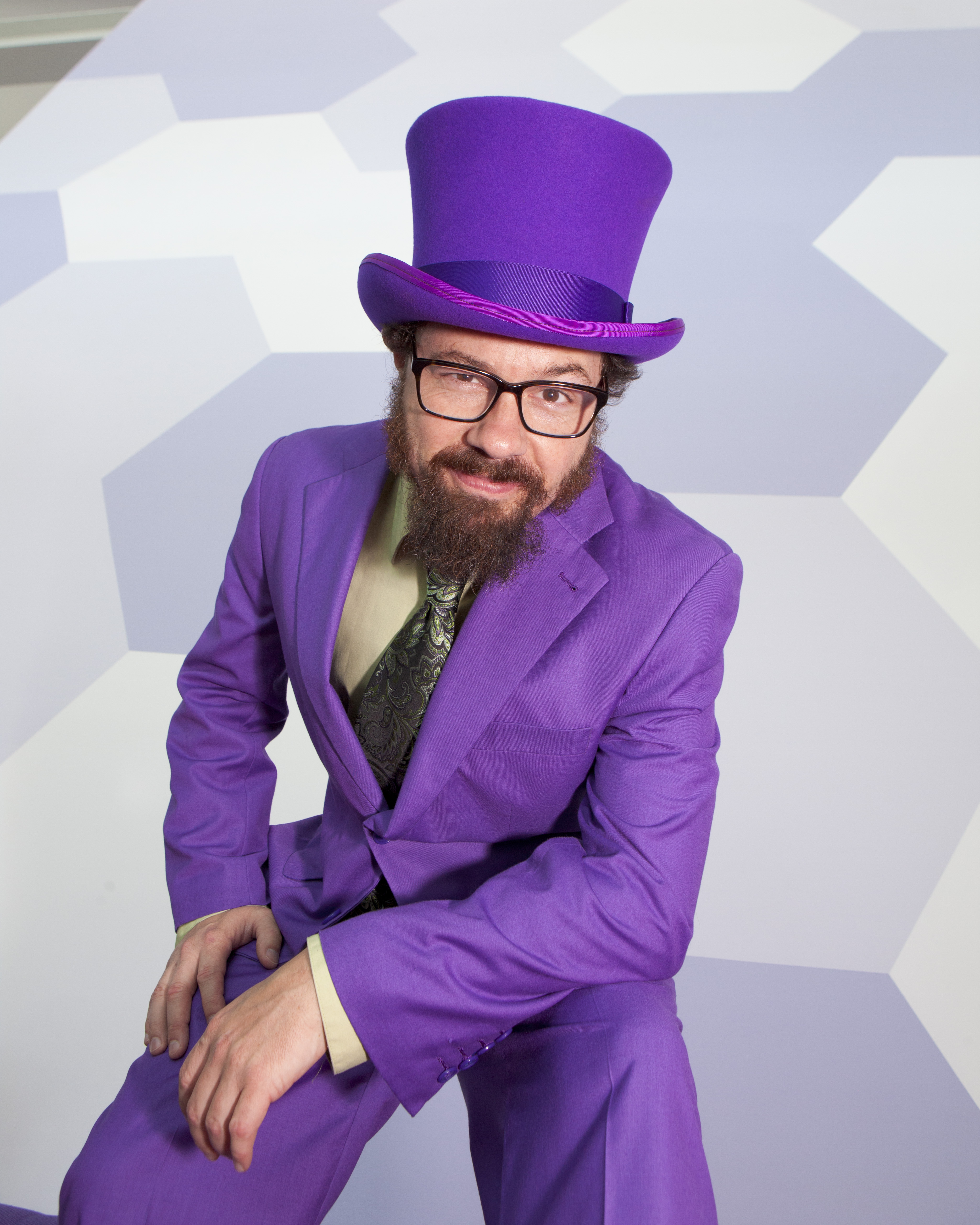
Brian Gorman, founder of Rock Band Land and drummer for Rainbow Beast

When I first heard Rainbow Beast’s debut children’s album, Tales from the Monstrosity Scrolls, I instantly connected with their sound and the stories within the songs. The content was dark, mysterious, imaginative, fantastical, absurd and profound. It lit up our living room! I immediately read their bio which led me to Rock Band Land, a San Francisco-based creativity program for Elementary school-aged children.

Brian Gorman, drummer for Rainbow Beast, founded Rock Band Land almost a decade ago and, with the help of co-director Marcus Stoesz, shaped it into an awesome program that ignites the imaginations of these kids. Rock Band Land offers so many benefits including teamwork, self-confidence, responsibility and how hard work really does pay off! To date, Rock Band Land has produced over 150 songs, 18 of which can be found on Tales from the Monstrosity Scrolls.

In the interview below, Gorman talks about how punk music inspired the creation of Rock Band Land, how an epic battle at the center of the earth inspired the name Rainbow Beast and the rules of Rock Band Land.

Kids Can Groove: Hi Brian! Can you tell me about Rock Band Land and your band Rainbow Beast?

Brian Gorman: Rock Band Land is a creativity program in San Francisco for Elementary school-aged kids. Rainbow Beast is the band that was born from Rock Band Land and it consists of my Rock Band Land teaching partner Marcus Stoesz, and our bassist, Jen Aldrich. Together, we write and produce all original stories and songs with the kids. The songs begin as stories and we collect the ideas for the stories from the kids. Then we move on to collecting musical ideas for the song, assembling those ideas into a full song that the kids learn, record and perform on stage in what we call The Big Show.

KCG: How was Rock Band Land created?

BG: I was a preschool teacher for 2 years in San Francisco, and then a few years before that I taught English in Japan for Pre-K through twelfth grade. While I was teaching, I was also a touring musician and when I would come back to the schools, I started bringing in really good rock music to share with the kids.

I thought I could write a punk song with some 4-year-olds. I started on a lark and, after a month with them, we finally wrote a song. It was really fun and it worked! Once I saw that that was possible, I slowly began to build it up. I tried one Saturday morning class with 4 kids to see if it would work outside of school and it did.

After about a year of experimenting with it, Marcus moved to San Francisco. Marcus and I met through our touring bands when we were on the road. Marcus is a phenomenal musician and he just happened to move to here at the perfect time, so I scooped him up and since then it’s just been full steam ahead.

KCG: Why did you decide to work with Elementary school-aged kids?

BG: That’s where magic is still real. When you are creating something, if you’re able to embrace the magic in it, you end up making better art. These kids have incredible imaginations and they’re not afraid to go into magical places, which makes the creative process so much more exhilarating for everyone. There’s very little resistance to going on an adventure and exploring our imaginations together.

KCG: In a mixed age class, do you find that there is equal participation between the youngest and oldest rockers? Are they supportive of each other?

BG: Absolutely! Honestly, the best classes we have are the ones that are mixed ages. The ideas are broader and more fleshed out when we’re talking about the stories. The older kids do a really good job of helping out the younger kids, and the younger kids look up to the older kids. We had a band with the greatest age disparity that we’ve had in any of our regular bands. A girl had just turned 9, and two other kids in the band had just turned 4, so there was a 5 year difference, and they worked unbelievably well together.

KCG: I can see how the different levels of maturity influence the content on Tales from the Monstrosity Scrolls. On first listen, it doesn’t strike me as a traditional children’s album. But, upon closer listening, I can hear how the lyrics fantastically reflect the kids’ ideas. It’s outstanding! The stories accurately express the things they are curious about and fascinated by. For example, “Ice Girl” is a story of a girl who emerges from a frozen lake as a superhero and uses her powers to save people from drowning in hot lava. What is your process for writing these stories and songs with the kids?

BG: We have very specific guidelines for when we are writing the songs. It’s all run by the kids, but our rules really help shape where we go, and provide boundaries for us.

1. The story has to be original. We don’t talk about Star War or Ninjago or whatever the thing is that they’re fond of at the moment. It’s all our own characters, our own storyline. Sometimes they’ll be scenes that you could say relate back to these things, but in the end the characters are our characters and the situations that they get into are all ours created with the kids.

2. Anything can happen but there has to be some redemption in it. Characters can die, there can be plagues, there can be floods, there can be fighting that happens but there has to be some redeeming factor to the story and that really guides us. When some stories are getting really dark, we ask the kids how we can find a positive outcome. Most of the rockers who have been with us for a long time really understand when we’ve crossed a particular line and that we either have to cut out or be turned around in a way that justifies where we’re going with the story.

3. No potty words or bad words. Basically, as soon as you allow the kids to start singing about poop that’s really all we’re gonna talk about.

4. This is an important one. The rockers can dislike anything they want. They don’t have to agree with where a story is going. But, If they disagree with the direction the story is going in, it’s their responsibility to change it and make it work for them. We work really hard to help the rockers understand that they are in control of their imaginations and that they are in control of their creativity. We set up a dynamic where there’s no judgment if a rocker wants to change something, especially if it’s around something that frightens them. For example, if a shark character comes up and a kid expresses a fear of sharks and asks that we don’t incude them in the story, we will work together to turn that character into a whale or something else that everyone can agree on. We continue working through this until we can agree as a group. Our process is basically like the first rules of improv. It’s always “Yes, and…” If you say “No” you block the process and it shuts the whole thing down. So the rule is that they have to keep going with the story and if they don’t like it they have to help us reshape it to a way that they like. It ends up working really well and reinforces the importance of being on a team.

KCG: Next to each song on Tales from the Monstrosity Scrolls is a band name. Can you explain how those names are created?

BG: Generally the first week of class is when we name a band, and we go through all the same rules I previously mentioned to come up with the final name. We use this initial process as an exercise to get the kids warmed up, working together and understanding that they can say silly things, and take chances. It’s actually encouraged because the sillier they get, the more creative they get, the more excited we get and the more positive feedback they get in return. We usually go through about 50 different name suggestions before we come on to the one that we then vote on and choose. In those 50 names there’s usually some really crazy collection of words.

KCG: Can you explain how the name Rainbow Beast came about?

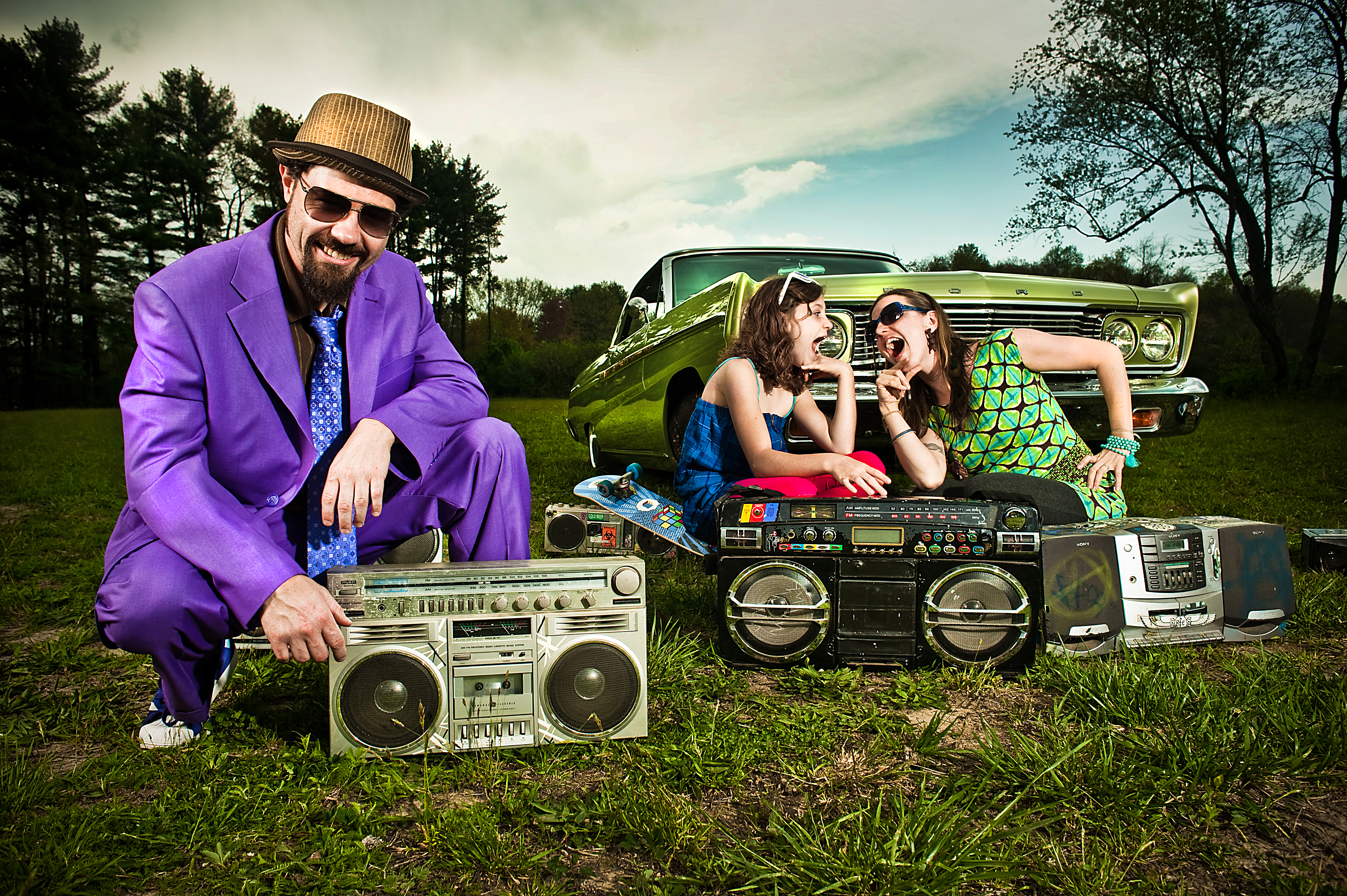
BG: There’s a mythology about Rainbow Beast that’s ever growing that we talk about in RockBand Land. The kids know there’s me and Marcus, and then there’s Rainbow Beast. Rainbow Beast is sort of like a hyper-realized version of each of our own personalities. When we play, we dress up and have makeup on that represents characters of ourselves. I’m a very high energy, very loud, vert spontaneous person. Marcus is very sensitive, very gentle, and very quiet, and Jen is kind of stoic and sharp and witty and dark. So we play these parts of our personalitithes that we like about ourselves, and that make us who we are, but are also fun and easy to embellish on in a theatrical performance sort of way.

0002276441_100
The name Rainbow Beast comes from a song called “Ninja Noodle” that we wrote 4 years ago. It was one of the first songs we wrote. Ninja Noodle is a noodle that is not happy with his regular life. He doesn’t just want to be a regular bit of macaroni and cheese. He wants to be more, so he trains, and he studies, and ultimately becomes a ninja. Naturally, every ninja needs an arch enemy. Trishta, part shark, part T-Rex, part tarantula meets Ninja Noodle and they have a pretty epic paintball battle at the center of the earth. They fight by firing paintballs at each other which hit and cover the walls of the center of the earth. The paint splatter ends up making this beautiful rainbow. Trishta and Ninja Noodle both pause at the same moment when they realize that while they were both fighting, the result of their fight created an amazing mural. They are so taken that they both fall in love and get married. So the “rainbow beast” is what they made on the wall and that’s how we see what the kids ideas are with us. They’re shooting us with their ideas, basically, and that’s how we collectively grow and thrive. They made us and now we’re here to care for their ideas, basically.

KCG: How did you come up with the concept for the cover?

The concept I originally had for [the cover] was that we were piñatas and the kids were beating us with sticks and color was flying out of us. After we talked it through a bunch, we realized that we didn’t want to promote anything that would be seen as violent or aggressive. We reshaped it into something that still went with a similar concept but is more playful.

For the design of the album cover, we enlisted some extraordinarily talented parents in our community. Two of our early parents, who became huge supporters of us, are Stacy Ransom and Jason Mitchell of Ransom&Mitchell. They are amazing fine art photographers and their son, a phenomenal rocker who’s been with us for years, appears on about 4 songs on [Tales from the Monstrosity Scrolls].

a2399111997_2

KCG: How did you choose the songs on The Monstrosity Scrolls? 

BG: Everything on the album was written in Rock Band Land. We were trying to figure out how we could include as many kids as possible on the record. There’s about 200+ kids on that record, and we wanted to make it clear to listeners that Marcus, Jen and I are playing the music, but this project is all about working with the kids so that’s why it’s Rainbow Beast and the Rock Band Land Rockers. And that’s why after each song we gave a nod to each band so that they are recognized for their work. They helped make it so they need to be represented. It is all them.

KCG: What percentage of the music on Tales is being played by the kids?

BG: All of the music comes from Rainbow Beast, though there are a couple of kids who are playing guitar on the record, and all the kids are singing on every song along with us. A lot of the kids come to us with zero musical experience and that’s totally fine. No musical experience is required in order to come work with us. Their ideas, however, are all over the record.

KCG: Can you share any interesting experiences you had while producing these songs?

BG: The beat in “The Ballad of Annabelle and Sam” was created by a 5-year-old playing body percussion. He came into class and said, “I know a beat,” and started doing this insanely cool rhythm. He kept the beat on his body, smacking his legs, his thighs and his chest, and clapping. He was also doing using his feet and it was so solid. We set him up on a bass drum and put mics all around him – his chest, his legs and his hands. We recorded his beat, looped it and put my drums on top of his rhythms. His rhythm became the foundation for the song and, as strong as the song is, his beat is what I love most about it. Everything you hear in that song was done at Children’s Day School in San Francisco in a classroom.  He is now one of my star drummers.

KCG: So, why did you release an official album?

BG: There are several reasons, really. To start, it’s to celebrate all the stuff that we’ve been doing and to celebrate the community that we’ve created. We had a big show to go along with the release which gave Marcus and I a chance to celebrate with the kids and their parents in honor of what we’ve worked on for the last couple of years. We are a hard-working band, and I believe that people will be really excited about the album when they realize the evolution of it all and hear the crazy stories that go with it.

We have all the stories accessible online for people for free and all the different components that we’ve been working on that are finally starting to come together. Our release allows us to hopefully announce and expand our community beyond the boundaries of what we have for a school. Rock Band Land classes stay small for very intentional reasons. We can’t have any more than 90 kids, and it’s just Marcus and I teaching and running music production. Our kids get so much out of it. In addition to the creative aspects, there are literacy components. Once we write the song, [The kids] all have lyric sheets and get one week to memorize the songs. Many of our kids use their songs as their reading work at home, and we use a lot of challenging vocabulary. We’ve seen countless examples with our kids where their reading and writing has skyrocketed because of this and they’re are extremely confident and proud of themselves. We see all these things that could work for so many other kids that doesn’t necessarily have to be in our program. Releasing [Tales from the Monstrosity Scrolls] is our initial step towards becoming a bigger entity and bringing all the fun and lessons from Rock Band Land out to the broader community.

KCG: The Monstrosity Scrolls is definitely going in a completely new and cool direction and stretches the limits of what we think of as children’s music. 

BG: As far as I’m concerned, there is absolutely no harm in sharing most any music with kids, especially if you share different kinds of music with and talk about what they are hearing in the song. I think you have to be careful with some of the content and some of the language. But, even songs that are very dark or aggressive, if you take the time to actually talk about what the words mean, or maybe ask the kids what they think the songs are about, you can breakdown most anything and find something redeeming in it.

Rock music, from the second it came onto the scene and people became aware of it, they were afraid of it. It was considered to be “the devil’s music.” When the Beatles came out, they were terrifying but wen you look at rock music now, there’s not a kid on the planet that doesn’t know the Beatles. The Beatles were considered to be inappropriate for kids when they came out, and now the first music most people give their kids is any Beatles’ record. Anything people are afraid of now, I feel that maybe there is a misunderstanding and wonder what is sparking that sensation in people, but I don’t think it necessarily makes it inherently bad or dangerous or necessarily inappropriate.

KCG: The first half the album seems to have a different feel than the second half. Is there a difference and, if so, was that done intentionally? Had you thought about dividing it up into two albums?

BG: It was gonna be 4. We were going to have 2 records; 2 audio and 2 radio drama records. It was gonna be this huge boxed set and our concern was that the record would go out and people wouldn’t realize that the songs actually come from stories and that we produce the stories with the same care and quality that we produce the songs. Then we started doing podcasts this summer and realized that the podcast is an easier way to connect people with the story content. So instead of producing something huge, like 4 hours of media for the kids, we just went with a full album of songs.

Marcus spent countless hours just going through trying to create the arc of the record that you are speaking about so that it had this different feel, and that it changed and shifted. So if you are paying attention there is an arc to it that’s hopefully enjoyable and gratifying. He put an incredible amount of time into thinking about that.

KCG: How do you describe Rock Band Land to parents of future Rock Band Land rockers?

BG: The first thing is that I give them tons of information beforehand where I tell them straight out that we are not afraid of the dark in Rock Band Land. We are going go to dark places and that’s because when we circle up with the kids and talk about what we want to write about, it’s all collaborative, it’s all led by their ideas, and we ask them straight out “What type of song would you like to write?” “What type of story would you like to write?” Inevitably, the first two requests, almost every time, are spooky or scary. The reason for that is because kids tend to feel a certain joy and thrill about exploring what scares them. But, there’s also some important developmental stuff going on where the kids are working through ideas. Kids are very aware of what they hear and their surroundings. They take all that stimulation in and begin to realize how they can relate in their own world. They think about what could actually hurt them, and begin to understand where they are safe and where they aren’t. Rock Band Land is a way for us to support these kids in a comforting environment.

The cool thing, though, that we offer that might be different in some ways is that when we send the songs home with the kids they have a week to learn it and it’s up to the family to learn it. We always send along the chords so if anyone plays piano or guitar at home, they can play along, and a lot of families use it as something they do before bed or on the way to school. [The kids] have to listen to it at least 3 times a day to be ready to record. We get a countless number of emails from parents who are psyched that they’re learning the song with their kids. It’s a bonding experience for everyone.
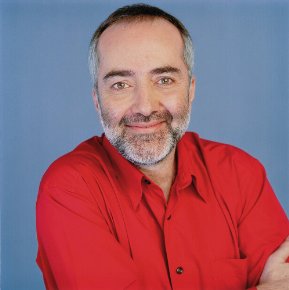
Beyond the music – An Interview with a Children’s Troubador: Raffi

71b+--pgRPL._SL290_

Raffi is back! After 12 years, this children’s troubadour returns with his new album, Love Bug, which is filled with his rich voice, and uplifting positive messages. Raffi’s music was a major part of my childhood and is now a part of my daughter’s childhood which makes for a nostalgic listening experience.

I had a chance to speak with Raffi about what he’s been up to since his last album, the significance of songs on Love Bug  and how they relate to the role of technology in early childhood, and just who Raffi is, beyond the music.

Kids Can Groove: Congratulations on the release of Love Bug! My daughter and I are getting so much out of the messages mixed within the songs on this album. Compared to previous albums, Love Bug feels like a culmination of your experience and the projects you’ve been involved with over the years. It’s as if  were inspired by these efforts and then moved to create a new album that reinforces the meaning behind these causes.

Raffi: I appreciate you saying that. I think Love Bug represents an evolution of both Raffi, the children’s advocate, and Raffi, the children’s troubadour. With Love Bug, I think you’re seeing and hearing a blend of the two which you might say is true for all my albums. If you go way back to the Baby Beluga album there was a song on there called “All I Really Need,” and it had a beautiful message: “All I really need is a song in my heart/ Food in my belly/ Love in my family,” so I’ve been sprinkling positive messages in my songs throughout my career and we might say even moreso on Love Bug, which is all about love in the real world; the human touch and the connections with nature, whether it’s water in the well, or the doggone woods. So there are songs that make you laugh, songs that make you think, songs for little kids to groove with and enjoy, and songs for kids and parents to enjoy together. I’m so happy with the feedback I’m getting with Love Bug so far. We had a wonderful new 5 star review on Amazon.com and it just made me smile.

KCG: With all of your experience and recognition, you still remain humble and I think that’s a testament to how you move through the world, creating and participating in things that speak to your heart. Your positivity is conveyed to children through your music. 

Raffi: Thank you. For all of us, the opportunity is to grow in our personal lives and grow in our capacity to love, and to love respectfully. Whether it’s in songs, or in parenting, this is what we’re able to cultivate and practice in our daily life, allowing us to grow into conscious beings.

KCG: I’d like to return to what you alluded to in your first response where you expressed that there are two sides of yourself – a children’s troubador and a children’s advocate. The question that comes to my mind then is ‘Who is Raffi?’ 

Raffi: Well there are many aspects of me. There is the musical Raffi, where the music is very strong within me. In fact, I missed writing new songs and sharing them with the world, which is what led to the Love Bug recording after 12 years.

There’s also Raffi, the thinker. It’s not that you can separate these aspects but since 1997 I’ve developed a philosophy called “Child Honouring.” In 1999, I wrote 3 paragraphs for a piece called “A Covenant for Honoring Children,” which was  inspired by The Declaration of Independence, actually (laughs), the beginning of which says “We find these joys to be self-evident that all children are created whole.” In 2006, I published an anthology of essays called “Child Honouring: How to Turn This World Around.” I co-edited that volume and I wrote the introduction and the concluding chapter.

I love the various hats that I wear, whether it’s essay writing or blogs, which sometimes I write for Huffington Post and others. I wrote and published a book last summer called “Lightweb, Darkweb: Three Reasons to Reform Social Media Before It Reforms Us” and I highlighted the very important issues of young users being safe when they’re online. So in these various ways I enjoy being the children’s advocate that I can be because, especially in this digital era, I think children face different challenges than before, and the same goes with parents.

If I can come back to Love Bug for a moment, you might say Love Bug is the first Raffi CD of the digital era. We’ve only had social media for 10 years but it’s so changed the way that kids, teenagers anyway, communicate with one another. [Technology] has changed parenting in the sense that parents have to be aware of what their kids are doing online, now keeping track of them in two different worlds. I wanted Love Bug to be an album that fully celebrates the real world, and to remind us of what our foundational experience is. I am glad I had a chance to do that.

KCG: Social media is definitely a whole different animal when it comes to how we relate to one another these days, and I think that applies to all ages. At the same time, technology is becoming a greater force in our children’s lives. For example, more educational games are being created and some schools are even starting to integrate the use of devices as part of work in the classroom. Do you feel there are benefits when technology is used in this regard?

Raffi: In my “Lightweb Darkweb” book, I refer to myself as a tech enthusiast and critique social media and infotech from this position as well. The benefits are there for sure but you have to think about what the downsides are, too, of offering infotech to children at certain ages. The American Academy of Pediatrics and the Canadian Pediatrics Society both advocate no screen time for children 2 and under and I wholly agree with that. They advocate very limited screen time for kids 3 and up, and I agree with that as well.

Screen limits are really important because when you’re a little child you’re experiencing what it is to be human. There are deeply important processes forming in the brain, the mind and the heart of a young being. What it feels like to be alive, to be human, is best experienced, nourished and cultivated in the real world of active play and exploration with caregivers, family members, and friends in real life. Three-dimensional marvels of the elements of the real world, whether it’s sand, water, mud, rain puddles or a sun beam through glass allow young children to experience the rhythms of the real world before they are bombarded with the hyper-fast flat simulation of virtual reality that infotech offers.

Now, obviously there are some instances, especially for kids of special needs, where an adult is working with a tablet or some other computing device to enhance communication and a child’s expression. I recognize those advantages and benefits, but generally speaking my message to parents is the same as what psychotherapists are saying, which is “infotech can wait.”

It’s important to say why that message, that advice is being given, because as I said, we need to have children exercising their imaginative capacities in their early years. There’s no benefit, no leg up, to a child getting to use infotech at an early age. Technology will change, it changes every couple of years, and it takes no skill to use it. What takes skill is interpersonal relations and “emotional intelligence,” which is one of the 9 Child Honouring Principles, by the way. Emotional intelligence is the work of the early years. We want our children to be deeply capable thinking and feeling beings, and that is best practiced with active play free play and the interpersonal relations of those who love the child.

KCG: How do you see music integrating into this philosophy?

Raffi: Well, music, songs, that engage a child can be wonderful just the way an illustrated book can be a marvel for a child. When you’re sharing a book with pictures, those pictures come to life through the child’s imagination. It is the child’s mind that is making those pictures move which is a beautiful thing. A song does a similar thing, especially just the audio. “Audio only” gets the mind making up pictures based on the words and that is also beautiful.

KCG: Do you think that music also has the ability to effect change?

Raffi: Well, the music is only a catalyst. It’s the young child’s experience of and response to the music that is making the changes in their brain and to their ability to express themselves. Maybe the child is singing along to “Love Bug” and the song is inspiring the child to hug mommy, daddy, brother or sister because of the lyrics referring to where the hugs come from. What is happening of value in that example is in the response to the song.

KCG: What was your childhood like? Were you exposed to music when you were growing up?

Raffi: I was! I appreciate your question. I was born of an Armenian family and my birthplace was Cairo, Egypt. My early musical influences started with my father who was a very fine musician and a great singer. We used to love it when he sang at family parties. I also remember hearing the radio playing both the music of Cairo, which is the Arabic music, a Middle Eastern, rhythmic, festive kind of music, as well as European music. I had no screens in the first 10 years of my life and I think I ended up doing rather well (laughs). I’m very happy for that. Later on, when I was about 13 years old, I joined the Armenian church choir in Toronto.

I’d like to go back to the point I made a moment ago, which is that you don’t need an early introduction to technology to do well with it. I didn’t start emailing until I was 50. I didn’t start on Twitter until I was 62, and I think I do fairly well on Twitter. I think there’s a lot of benefit to waiting.

KCG: When you were young did you think about becoming a musician? Do you remember the defining connection that prompted you to begin making music for children?

Raffi: When my album Singable Songs for the Very Young was produced in 1976, it was so instantly popular that it made me think “Hmmm, maybe I have a gift (laughts) to make music for children.” As I played over the next two years, I was singing in nursery schools, libraries, as well as coffee houses. So many families came to see my children’s music that within two years I decided to concentrate solely on that. As of January 1979, I was a devoted, dedicated children’s entertainer. My autobiography, “The Life of a Children’s Troubador,” details the transition from being a folk singer, which was in the early 1970s, to children’s entertainer. The transition took about 2-3 years.

KCG: I suppose I asked the previous question because you have devoted a lifetime to being a children’s advocate through the Child Honouring philosophy, as well as making music for children. I’m interested in hearing about the passion that continues to drive you to be involved in these various aspects.

Raffi: Well, it’s my love of life and my love of children and the unique beings that they are. I often say a child is the best of who we are because the child is spontaneous, joy filled, pleasure seeking and meaning making. The child is the human explorer, the universal human. Infants, of every culture, regardless of skin color, ethnic origin, or social standing, are the same physiologically beings and it’s there that we see how much human families of diverse cultures have in common. These similarities inspire us to love one another, to cherish our differences not to fear them, and that’s a message that we need to hear and practice more and more as we hear disturbing accounts of violence around the world, whether it’s in the Middle East or elsewhere. The society that births children needs to be a child honouring society, one that respects the very young for the whole people that they are and the innate brilliance that they’re born with.

KCG: The song “Seeing the Heart” seems to speak to what you are saying here. You refer to a child drawing a “hate outtake valve” which just really underscores that children tend to see a world full of love and beauty and wonder. Can you talk more about that song?

Raffi: The song “Seeing the Heart” was inspired by a drawing made by friend of mine named Tania Godorojia, an artist and art teacher. She drew a black and white drawing of a human heart and her then 10-year-old son, Serge, came to his mother’s drawing without any prompting and started labeling various portions of it with words like “pump of flowing happiness,” “hate outtake valve,” “ridge of forsight.” He called the whole thing “The Mind’s Way of Seeing the Heart.” It was an astonishing array of words by a 10-year-old and then I thought it was such a striking combination of mother and son connection that I made that song about that drawing.

KCG: Since your last record did you continue writing songs?

Raffi: I did, I just hadn’t recorded a children’s album. I wrote a song called “Cool It” about global warming, and a number of individual songs, but they weren’t really for children’s albums so to speak.

KCG: You performed for Nelson Mandela.

Raffi: That one we did include as the bonus song on this Love Bug album. [Nelson Mandela] was such an inspiration. He’s humanity’s hero and I loved singing this song for him. He stood up to shake my hand. It’s moment i’ll never forget.

KCG: How do you feel Love Bug came together for you? In any different way than your previous albums?

Raffi: Actually, it came together easier than any album in the past. I think I was so ready (laughs) after 12 years to do this and the songs came beautifully and very easily. The whole thing flowed. It was so enjoyable that I’ve got another album planned for next year.

KCG: So we can expect some more Raffi.

Raffi: Oh! You bet! I’ve only just begun!

KCG: Are you going to be doing live performances?

Raffi: Yes, I will be doing select concerts. We will be posting information on http://raffinews.com. People can also follow me on Twitter or my Facebook page. There will also be information at http://childhonouring.org.

KCG: Great! Thank you for your information and time!

Raffi: My pleasure. Thank you very much.

Elska’s next steps: The New Victory Theater LabWorks Artist Residency program accepts Elska!

SocialMedia_Labworks_Residents-08

When my daughter and I first experienced the colorful world of Elska we were taken by the intriguing story of a modern pioneer living on an arctic island containing a land of lost socks, an arctic fox and the Goobler. Elska is a magical character brought to life by Shelley Wollert and producer Allen Farmelo. In the performance of Elska’s first album, Middle of Nowhere, the audience is transported into Elska’s fantastical world in a theatrical way that taps into the most magnificent parts of a child’s imagination.

Recently, Elska received an amazing invitation to be a part of The New Victory Theater’s LabWorks artists’ residency program, guided by The New Victory Theater programming department under the leadership of Mary Rose Lloyd, the theater’s Director of Artistic Programming. Elska was one of just ten artistic teams to be offered expert support as well as the opportunity to use the theater’s state-of-the art facilities to develop a new performance piece as well as an accompanying album.

Jonathan Shmidt Chapman, Associate Director of Artistic Programming at the New Victory Theater noted, “We’re delighted to welcome Elska to the 2014-15 New Victory LabWorks Artist Residency Program. Elska is a unique and innovative artist, merging music and theatricality to provide a one-of-a-kind experience for family audiences. We are looking forward to providing space, support and feedback to Elska as the artists develop a totally new work, writing new content (music and narrative) and enhancing their musical stage show for a theater venue.”

I was so excited about this announcement that I wanted to catch up with Allen and Shelley for some Q&A about what their future plans are.

Kids Can Groove: Congratulations on your residency with The New Victory’s LabWorks program! What an incredible opportunity!

Shelley Wollert: This is truly an amazing opportunity for Elska to create a new piece and a new album with the mentorship at the New Victory Theater, which is cutting edge, so well respected and internationally known. It puts a tiny spotlight on Elska in that community which is really a nice introduction for us into the theater world. It’s just a great thing to be a part of and we’re super excited to get started.

Allen Farmelo: When I consider this opportunity in the broader context of how public funding for the arts has been consistently drying up in the US, I feel that what LabWorks is doing is not just visionary in the artistic sense but socio-economincally and politically ambitious and forward looking. I feel extremely honored to be a part of their mission to support performing arts for young audiences.

KCG: Can you explain what you will be doing during your residency? Will you be expanding upon Middle of Nowhere?

SW: What we’re doing at LabWorks is going to be creating an entirely new piece and a new album simultaneously.

AF: When we created Middle of Nowhere, we made an album and then created a live show to go with it. What we want to do now is create the music, the theatrical piece, the props, the production and the lighting
simultaneously. With LabWorks we have the opportunity to play and experiment in real-time with the added benefit of mentorship from directors, lighting techs, prop makers, set designers, producers, etc, who are very familiar with theatrical elements.

KCG: How did the transition to theater come about?

AF: The transition to theater grew out of our live show, Middle of Nowhere, which is based on our debut album of the same name. Over the past couple of years that we’ve been touring Middle of Nowhere we’ve had the opportunity to perform in clubs and in theaters, the latter of which provided a proper lighting setup, an expanded stage setup, and a seated audience. What we found is that the show really worked well in theaters. The children were transfixed and the parents were able to engage with the children more as true audience members, rather than as chaperones to what is often just a child-centric concert experience.

SW: To further underline what Allen is saying, instead of [Middle of Nowhere] being just purely a concert, our live performance is turning into something that is more of a story line, involving many theatrical elements that transports the audience to a setting that goes beyond a typical concert. When we heard about LabWorks we felt that was the perfect opportunity to allow us to grow in that area.

AF: We ended up showcasing at a booking conference called IPAY (International Performing Arts for Youth Conference) and while we were there we saw a broad range of international children’s performances. When we saw our musical act in that context and with a character and a script, we realized that we are more than just a musical act. What further solidified our thoughts was when we performed at the Alden Theater in Virginia because they billed our show as Elska performs “Middle of Nowhere” as if it was a theatrical piece rather than just a concert. That changed our paradigm up even more and we started really considering pursuing theater. The album title grew into a performance title and that changed our paradigm up. So when we heard about LabWorks it was the perfect fit for us.

Wollert-Farmelo Press Photo July 20143

KCG: Have either of you done theater before?

SW: I have a degree in performing arts and a background in acting. I was an apprentice at a really great theater called the Actor’s Theater of Louisville in Kentucky which had a really strong acting program. I also studied in London and in college, as well, so for me bringing Elska into the theater is such a return to my roots as a performer.

AF: Shelley is maybe being modest in this regard. She has a long history as an actress, and also played Joan of Arc in a solo show called The Passion Project which was reviewed positively in The NewYork Times. It was one of the most amazing deconstructed multimedia pieces I’ve ever seen. I saw Shelley perform there before I even knew her and it blew me away.

KCG: That must have been a very emotional performance I imagine. 

SW: Very. The Joan of Arc show itself was physically intense as well which is something I’ve been drawn to as a performer. Just recently, I did an acting intensive at Brooklyn College in a technique that was created by a French master director named Jacques Lecoq. I threw myself into this class and it was physically and mentally demanding and so amazing. Right now, as an actor, and with the LabWorks opportunity, I’m ready to really push myself to grow and to really reach my own physical potential.

KCG: I’m curious what your approach to this production will be like in the theater because you will be developing a story and the music at the same time which is a different creative process than they way you approached the production of Middle of Nowhere.

AF: We have an interesting challenge ahead of us. We don’t want to make musical theater in the traditional sense of a broadway musical, we want to do something different. For our current live performance, Shelley performs as Elska based on a script she wrote which weaves the songs from the album together. During our residency with LabWorks, I see us going even further into the sounds of Elska’s life and the actual soundscape that she exists in, which is based on Iceland. I think young minds are very open to a sound based experience so we would like to blend sound design and actual songwriting into something that ignites their imagination rather than filling it entirely, as one might with songs that advance the plot in musical theater.

Instead, what we envision is that Elska makes music in her life and she’s going to create moments of that on stage where she would be out on the island, naturally, and then the children will fall into that moment with her. What is interesting about performing for young audiences is that they can’t hold a plot line for very long, so there’s this ratio of plot to ambience that you get to play with. I’m most interested in creating magical moments that are wonderful and memorable rather than a traditional theater piece with various scenes, acts and a whole narrative arc. The opportunity to create music that isn’t necessarily advancing a plot or a story but creating a feeling or a mood is a greater challenge that I’m looking forward to. In the last record, we did some of this with songs like “Arctic Fox” where we created sounds that imitated a fox’s whiskers moving around. We used bells for the “Elska Express” and you can hear the train in the background, too, so there is a bit of sound design there which we currently incorporate into the live performance of Middle of Nowhere.

KCG: I remember the video for “Arctic Fox” had sounds that were perfectly timed with Elska’s facial gestures. It really feels like a whole piece.

SW: Exactly. For me, movement and sound should not be separate from one another. There is an acting method called Viewpoints that was adapted for stage by a director named Anne Bogart. One of the Viewpoints, according to the method, is called kinesthetic response. Basically, when something happens it causes a reaction. If a door slams on stage, a person appears to sit down at the exact same moment, or when a bell rings, Elska’s head is compelled to move at the same time because of that kinetic force and that action and reaction that happens. When we create this piece, and I perform this piece, it’s really important that my full physical body is tuned into these sounds and the angles of the stage so that it can be completely aligned. This also relates back to something I learned from my acting class in the Jacques Lecoq method which was the theory of le jeu which means play. An actor who can play is an actor who is interesting to watch, and we know this with children as well. A child who is playing and is in that imaginary space is totally engaged in that moment. When Allen and I are at LabWorks, one of the cards I’m going to have on the wall will say le jeu. From play, from engagement, and from these actions and reactions that we’re creating, we’re going to be in this new world that will be exciting to watch.

Elska-with-geysir

KCG: It sounds really magical. I can just see the theater as being part of the scenery. The audience is going to be teleported to another place for the duration of the show.

AF: It’s funny because I’ve always been interested in making albums that were worlds unto themselves. My favorite records, from front to back, are the ones where you feel like you’re in one unified world, and that’s what we’ve tried to do with Elska. For the new piece, we want to make sure that our work continues to feel like one unified world.

KCG: How do you see LabWorks supporting you throughout the development process?

AF: With LabWorks we have the support of a community of really excellent and pretty experimental theater makers. When you see a lot of the work they present, domestically and internationally, some of it is very abstract, very avant-garde theater which is a really good fit for us because we want to push Elska further into abstraction. The question we want to explore is how to do that more elegantly and more imaginatively. We always think of Elska like Legos. It’s an open-ended toy and we’re expecting a child to take that toy and turn it into something. We want to present building blocks for the imagination. We’ve been really cognizant of that with the development of the plot in Middle of Nowhere. I’ve seen 2 and 3-year-olds completely engaged in Elska just absolutely dive in and start creating their own stories, their own plots, their own bits, and so we’re cognizant of not handing a closed-off narrative, but one that is open and leaves the child with possibilities and questions. Rather than pondering a completed plot, we are inviting them in and encouraging them to create that plot themselves to some degree.

SW: Exactly. Allen and I are both excited by things that are a bit absurd and not literal, so we’ll be pursuing those types of ideas. When I think about the song “Winter Bear,” or an actual polar bear, there are many ways you could create a polar bear on stage. I am excited to talk with the talented people at The New Victory Theater and discover how to bring an imaginary character like this onto the stage in new ways.

KCG: Since the debut of Middle of Nowhere, you have devoted a lot of time to developing Elska and Elska’s world. How will you maintain your vision while also incorporating feedback from the LabWorks panel of experts?

AF: That’s a good question, because when a creative team partners with a larger entity one wonders whether creative autonomy will be minimized at all. But, I have one-hundred percent confidence that working with The New Victory Theater is going to add integrity to what we do and help our next piece become more like Elska than it already is. It’s time for us to go further into our instincts and gut feelings about this vision we had, time to develop Elska into something even more unique. Their expertise and level of professionalism, knowledge, depth and dedication to theater for youth is a total gift for us. We’re the company creating the work and they’re the theater providing support for us to do our work and further realize our vision. The beauty of the LabWorks residency is that we have total creative autonomy over our work while being educated on techniques that will help us get closer to what we really want our next piece to be.

SW: It will be interesting to get The New Victory Theater’s input on that. Through LabWorks, we are going to be given professional development opportunities to meet with their technical team and education department to talk about those aspects of Elska. They have an incredibly robust and talented panel of experts that I am excited to learn from.

KCG: As you prepare to enter into a more theatrical space, do you feel a greater responsibility to deliver a compelling performance? Are the stakes higher now? 

AF: With the new piece we are trying to create a lot of new things, so in that sense I feel a growing responsibility to the audience to provide excellence across a bunch of mediums. At the same time, I am also cautious about creating based on the audience’s reactions to our work. I always say the greatest enemy of creative work is the imagined audience because if you create based on an imagined response you aren’t listening to your own vision. I prefer to make sure that I have a responsibility to the work itself. As a producer, I am very interested in creating something that is functioning and beautiful on its own terms. While I do keep the audience in mind, I also want to come at the work without a set of expectations that I believe other people would have.

With Middle of Nowhere, we give the audience a sense of really being inside Elska’s world by creating an imaginary world and now we’re getting ready to make an imaginary world in three dimensions because theater does that amazing thing of putting a real person in front of you.

***

As the adventures of Elska advance into greater heights, fans will still be able to catch the current production of Middle of Nowhere as it continues to tour over the next year.

To find out more about the magic of Elska, visit her online where you can find her touring schedule, view videos and get to know some of the characters that also play an important role in bringing Elska’s story to life.

To find out more about the incredible LabWorks residency program visit New Victory LabWorks.

Interview: Secret Agent 23 Skidoo – It’s the Year of the Weird!

Secret Agent 23 Skidoo_Solo_photo credit Ian Ibbertson

June 24, 2014 marked the official release of Secret Agent 23 Skidoo‘s latest album, The Perfect Quirk, and his first book, Weirdo Calhoun and the Odd Men Out. In honor of these two releases, Skidoo is running a contest called Year of the Weird which encourages kids to get wildly creative by creating a destiny for an imaginary friend named Pickles and Weirdo Calhoun.

Skidoo is a kid hop (kids + hip hop) virtuoso known for his wicked lyrical abilities. His rhymes flow with conviction and heart, consistently encouraging kids to embrace their unique qualities and be proud of who they are. In the following interview, Skidoo shares his thoughts on being weird and following your heart. As a parent and a writer, I found Skidoo’s thoughts to be extremely inspiring and I trust that you will too.


KCG: Can you explain for my audience what the Year of the Weird is?

Secret Agent 23 Skidoo: It is the celebration of the beautiful mutants we all are. It’s the resistance fight against Madison Avenue created mainstream normality blandness. It’s the belief that weird is not the exception to the rule, it’s the only reality, whether people want to admit it or not. It’s also the art explosion of my new CD, The Perfect Quirk, and my new book, Weirdo Calhoun and the Odd Men Out, with which I hope to spread wonderful weirdness across the globe. And it’s the name of a contest I’m holding where kids can win a GOLDEN TICKET that gives free access to any 23 Skidoo show ever, for life. Go to www.secretagent23skidoo.com for details…..

KCG: Why is this a special theme and how did you come up with it?

The etymology of “weird” has its origin in the Old English word “wyrd”, which was a noun that means “fate or destiny”. I want to help kids understand that their weirdness is their destiny, and that they can ride it like a tidal wave of awesomeness to great spiritual riches.

KCG: What does being weird/the perfect quirk mean to you? In your music, it seems to have always equated to being beautiful, celebrating who you are and that we are all different and special in our own way. 15004_6PAN_1TRAY_STANDARD

Weird means interesting, authentic, unexpected. It means not basing how you act, look and create on what others are doing or expect from you. It’s good to be aware of other’s opinions, but not to let them dominate your natural self.

KCG: Your consistent theme has been an advocate for accepting yourself and reinforcing the value in loving yourself, i.e. “Gotta Be Me,” from your album Easy, encourages kids to be their own best friend. How have you modeled/reinforced that for your daughter Saki (aka MC Fireworks)?

I try to teach by action, and I live my life as a stubborn weirdo. I also have written about 5 songs for her that she gets up in front of crowds and repeats over and over, show to show, and has since she was five. So, a sort of positive brainwashing program, I suppose.

KCG: Do you consider yourself weird (unique)?

Indeed, and I was identified as a weirdo as far back as I can remember. The unique mix of my heart and intellect result in me having a different perspective on things pretty often. My own personal facet of the gem that is temporal existence. As a kid trying to fit in, it sucked, but as a professional artist trying to stand out, it’s perfect.

KCG: Are there times where you still feel like an outsider or rebellious? In “Gotta Be You,” from your last release, Make Believers, I recall you saying — “a misfit always been different, that’s probably why I became a musician,” for example.

Yup. I am naturally rebellious against any institution or establishment that seeks to normalize or homogenize the people that belong to it. Humans are naturally complex, quirky and unpredictable, and trying to treat them any other way only dilutes the beauty that we came here to experience. And from fashion choices to how I speak and carry myself, I continue to stand out. Sorta on purpose by now probably.

KCG: I like how you express passion and ambition in the face of adversity with the lyrics “While they were making fun/ Cupid was shooting his arrow in my heart ’cause I love to rap/ Years later/ My songs are like thunderclaps…” (“3 Pointed Back,” The Perfect Quirk). 

What would you say to kids who want to be creative but might feel insecure because of peer pressure or just simply unsure how to engage that part of themselves?

First off, don’t worry if your first attempts at creativity seem stupid or you feel you can’t do it…..That’s how every great artist started. I have notebooks full of rhymes I hated while I was writing them. Just try to have fun with it, and if you keep at it, eventually you’ll develop the skill to do something original and great. And if other people make fun of you or try to make you feel bad, just remember that later, you’ll have skills and an art that makes you feel amazing, and they’ll have nothing but the ability to make fun of things. Unless they become famous stand-up comics. Then I guess it works out for everyone!

KCG: What message do you have for kids to own their quirks and not fall into the popularity trap? For example, when you say “Yup I’m weird I love it I’m as weird as can be!” (“Gotta Be Me”)

Listen to your heart. It’s hard to do, but if you learn how to feel the difference between not doing something because you’re afraid and not doing something because it’s not the right thing for you to do, that will help you find the path. Also, give things more than one chance. If you feel like you want to try something new, do it at least 3 times with heart before you give up on it. And remember that most kids want to be popular because they’re scared that they’re not worthy enough by being themselves, so they want to fit in with a group to seem bigger and stronger. Animals do it too.

KCG: What helps you write/think creatively? Do you have rituals you follow that inspire your own writing?

Yup. I get good sleep, meditate, sometimes chant mantras to Ganesha, the Hindu god of writing and the remover of obstacles and Saraswati, the goddess of playing music, flow and wisdom. And walking always help break through any writers block.

KCG: What is the creative/writing process like for you – coming up with the topic for a rap, creating and then recording it?

Coming up with it is vague, nebulous and magical. Writing it is structured, workday stuff, but if I do it right, I’m more energized than tired at the end of the day. Recording it is a little tense and emotional, but mindblowingly awesome and transformative. Like childbirth.

KCG: What have you learned since your first album and how have you evolved as a kid hop artist?

I keep experimenting with the complexity. I am constantly figuring out the difference between simplifying and dumbing down. And my stage show is getting WAY better! Purple suits, tophats, motown dance moves…We’re stepping it up!

Secret Agent 23 Skidoo LiveCrowdRocking_photo credit Ian Ibbetson

KCG: Your music and lyrics are tight and flow really well together. What is your work ethic like? Do you hold yourself to a higher standard with every new release? 

I think I did until Make Believers. Then I realized that it’s not a competition with myself, it’s just a challenge of channeling what I have in my head and heart into the final product clearly. I don’t need to be better than I was, I need to be as good as I am, ya dig?

weirdoKCG: Why did you decide to write a book and not turn one of your existing songs into a book?

I still might turn one of my songs into a book, “Last Dragon” perhaps, but I just like to write new stuff, and I wanted the story to be a bit longer than my songs are. I feel like in a song, the whole verse has to make sense, but in a book, every page has to make sense by itself. So I’m experimenting with a new form, and it’s fun. And it turned out awesome, so I’m stoked.

KCG: From my daughter: What is it like to rap?  

It’s like shooting perfectly formed shapes out of your mouth that explode like fireworks and fall onto the crowd like nice cool rain on a hot day. Saki’s answer: It’s like a combination of yelling, singing and talking, but with more rhythm.

KCG: What are the most frustrating and most inspiring parts of what you do?

The most frustrating is that almost nobody knows about what we do, but everyone knows about the latest Disney movie. The most inspiring part is having a kid quote your lyrics back to you out of the blue, when you can tell they totally understand what you were thinking when you wrote them.

KCG:  There has always been a strong family tie-in with what you do. “Time Machine” is a beautiful letter to Saki. I especially love what you wrote to her in The Perfect Quirk’s liner notes: “I feel so lucky that even without a time machine, I still get to meet the future you.” Have you always written rhymes with Saki? Has she come up with her own creative endings to your stories? The Year of the Weird contest seems like such an awesome opportunity for families to experience together.

Yeah, I’m her ghost writer, but it always starts with me asking her a lot of questions about whatever the topic is, so I can represent her viewpoint correctly. And she’s written one song completely by herself, called “Rocket Science“, which is on the album Science Fair. She doesn’t have the passion for writing that I have, but she’s incredibly good at it when she does it. And yes, the contest is an amazing opportunity for families to collaborate on something creatively! Go do it! You can do anything you want….write a song, a story, a poem, make a sculpture, film a movie, do an interpretive dance, make a Tibetan sand painting…seriously, the weirder, the better.

Secret Agent 23 Skidoo and Family_photo credit Mike Belleme_high res

World Premiere: “Rainbow” – Karen K & Mista Cookie Jar

a3154349630_10

Children are naturally curious and one of our most important responsibilities as parents is to satisfy their hunger for knowledge about themselves and their world. As the mother of a very curious 5-year-old daughter, I am always conscious about communicating with her as honestly as possible. She is at a critical age where her opinions are becoming stronger and justified based on what she regularly sees and hears. And that scares me. It also drives me to find ways to reinforce values that will shape the way she sees and treats others as she grows up in our complex, ever-evolving society. While she is still years away from understanding the true meaning of social justice, her internal drive to make things right, whether it’s protesting about litter or standing up to a bully on the playground for poking her friend’s stuffed bear, is inspiring.

Music has regularly been a vital catalyst for spawning many of our discussions. Today, I am proud to premiere a song that Jeff Bogle (Out With The Kids) asserts “will up the ante on the political, world-changing capabilities of kindie music, essentially retesting the waters to see if kid’s music can indeed change the world in the 21st century.” (credit: Jeff Bogle, “Why Can’t Kids Music Change The World?“, Cooper and Kid)

Karen K (of Karen & the Jitterbugs) and CJ Pizarro (a.k.a Mista Cookie Jar) have produced a song called “Rainbow,” which explores themes such as racial and cultural inclusivity, showing one’s true colors despite societal gender expectations, and the placement of current social change and civil rights issues into a historical context.

Just as I was completing my introduction for today’s post, I found a picture my daughter drew that has just a rainbow and the words “you r mi love” on it. She draws rainbows all the time and although she wasn’t drawing it because of this topic, it so genuinely represents the purity, love and innocence of a child‘s mind. There is so much potential for learning, understanding and acceptance before children are truly “affected” by other people’s fears. So why not teach them that the rainbows they draw are inside of them, teach them about their potential and plant seeds that will, as Karen says in the interview below, teach them to stand up for themselves and ultimately find justice in what’s right not necessarily what’s popular.

Download proceeds for “Rainbow” will benefit the fight for equality and LGBTQ rights.

Learn more about “Rainbow” at the newly launched site http://iwillbearainbow.org and through their Facebook page http://www.Facebook.com/IWillBeaRainbow.


Kids Can Groove: How did you two first meet and what prompted your collaboration?

Karen K: We’ve actually only met in person twice! We first met at KindieFest in New York last Spring and again 2 weeks later in Boston when Mista Cookie Jar & The Chocolate Chips came up to be a part of the One Family Music Festival, a family music festival I’d put together with help from the Boston kindie community in response to the Boston Marathon bombings. We were all thrilled Cookie was part of such a great day of healing for families. Come to think of it, I guess this song is our second collaborative-attempt at using music to make a difference!

C.J. Pizarro (a.k.a Mista Cookie Jar): it was an honor to be able to help out for such an important cause. It struck me from the get-go that Karen was very committed to making a positive difference in the world through music. After the festival, we began collaborating on a song cross-country. We had a few fun ideas immediately, but it wasn’t until a few months later when she sent me the “Rainbow” demo that the creative gears really started to turn for us.

Lyrically, it seemed like a very natural subject matter to flow over — and urgent as well. In terms of justice, I’m always down to support the cause, and it’s special when you have something so full of heart that you think might actually make a big difference!

Any creative opportunity to affect social change is a rare one. Karen’s hook was just so emotional, simple, and meaningful — from the smart-phone recording alone, I knew there was good power there. The MC in me really loves a good hook — which really becomes your mantra/inspiration for every lyric you write.

KCG: What inspired you to write this song?

Karen: “Be a rainbow in someone else’s cloud.” – Maya Angelou. I love that quote.

While I’m a straight woman, I have many, many gay friends and colleagues. Back in February when Arizona tried to pass their anti-gay legislation, which thankfully the Governor vetoed, I was really upset and like a lot of other people, I thought, this type of thinking, this type of behavior, this type of governing should just not be happening. Although marriage equality and LGBTQ rights has long been an issue I care about, it occurred to me in that moment that this is the civil rights issue of our time, and of our children’s time – my own child’s time. And I knew, for me, I needed to do something.

At the same time, a gay friend of mine from my musical theater days in NYC posted on Facebook that he was devastated and that he felt he could not return to his hometown of Tucson. It broke my heart – and actually helped fuel the song. I sat down at the piano and wrote the “hook” or the chorus – “I will be a rainbow, I will let my star glow…I can chase the fear back into the night…” I wanted to look bigotry in the face with a message of hope – something that said that we can stand for love in this hatred, no matter what. I think at the time it was also a commitment to myself – a personal commitment to take a firmer stand on marriage equality and LGBTQ rights, because enough was enough.

I’m lucky because I was raised by loving, socially-conscience parents who taught all three of their kids to treat all people with kindness, and to stand up for what is right. My parents are from Greensboro, North Carolina, where they lived through the Woolworth’s sit-ins and events that drove and were tantamount to the Civil Rights Movement. Josephine Boyd, the first black student in the country to enroll at an all-white school, was a classmate of my parents at Greensboro High in 1958. I mean, they were in the thick of it. And their ideals were firmly planted not always on the popular side, but rather the right side of history. This was not lost on me as I drew the connections between the fight for marriage equality and LGBTQ rights in 2014, and the 1960s. It’s a great lesson in parenting actually; they passed their values onto me – to all three of us kids – by example. I think we live the way they live.

I sent CJ a scratchy little recording from my phone and out-of-tune piano and asked if he wanted to write this song that addressed these issues – a song of hope and justice and acceptance and love…for kids. And because he’s CJ and basically IS a walking rainbow, he of course said absolutely, and through emails we started talking specifically about what the song should be. We “got” each other right away. Though we have completely different musical styles, that was part of the beauty of working together.

CJ: I can empathize with anyone who is bullied for being different or not fitting in to what society deems as normal. I’ve always found this disturbing. I think in a way when it comes to gender issues, it just comes down to aesthetics and what people are used to and how willing people are to think outside their own box. People are driven to rage and hate because other people are so different than they are. Because it doesn’t fit into their world or perspective, it challenges them. I think its a dangerous mindset that leads to wars and oppression. Connecting to children at a young age with open-mindedness and free thought with such issues is key for progress. The revolution continues with the children. To grow as a people, we must educate our youngsters and hopefully our stubborn habits rooted in close-mindedness and exclusion will subside.

I believe music changes lives and helps pronounce movements. I’m deeply influenced by activists like Noam Chomsky, Cornel West, Edward Said, Howard Zinn — and musicians who merge their activism and artistry like Bad Religion, Rage Against The Machine, Tom Morello, Omar Offendum, Outernational and the Beatles too — especially John Lennon — just to name a few. I feel children’s music to be just as powerful and KEY to social change. Creating a song like ours was very interesting to me and quite a natural fit. I was happy to read Jeff Bogle’s article and how he gave it up to Woody Guthrie & Pete Seger. Folk music and activism seem to go hand in hand. They work together so organically. After all, it’s music for folks. For many people of my generation (new parents included), both urban, suburban and even rural folks, hip-hop is a new folk music, if not THE new folk music. At its best, it seems to be a great way to break down ideas expositionally and emotionally at once. In its socially analytic nature, [hip hop] seems to be rooted in the same soil as folk. Creating a pop song with such socially conscious themes was something we thought could reach many while simultaneously raising a myriad of important and current issues.

I was also inspired by the spirit of punk rock, which gives me the strength and vigor to take a stand and not really give a hoot. Given the genre that we’re in, children’s music, I find it very interesting how such a song full of the spirit of inclusivity will more than likely infuriate many parents out there (if they hear it) who are diametrically opposed to our world view. It seems to be human nature and the current sociological climate we live in. But at least it’s a song of universal love and not a stick/stone/mean tweet. Let’s begin a meaningful dialogue with folks diametrically opposed to us! That’s progress! That’s punk rock!

KCG: What do you want families to take away from this song?

Karen: We hope of course that kids of all ages hear it and really get the message that they are special and unique and phenomenal no matter where they come from, what color their skin is, what their sexual orientation is, what the make-up of their family is. As CJ says in the song, “You be you, through and through.” We hope this song will be a catalyst for direct and honest discussion in families, at school at the playgrounds – among kids and adults – and that it changes the dialogue. I hope [families] sing along and that somehow this message seeps into their beautiful brains and hearts and they remember it. We also hope they hear all these other great songs with similar messages written by our amazing colleagues and that they play them on repeat. (The Not-Its just released a song called “Love is Love” that is great). And we hope that their parents and teachers show [kids] again and again that they are loved because of who they are, because they are so perfectly beautiful just as they are. CJ talks really poetically about this in the song.

CJ: Wether you are in a lefty community or one not so LGBTQ friendly, my hope is that with this “redemption song” floating in the ether, there will be a source of hope for oppressed souls to cling to, a set of rational ideals to meditate on, and an unadulterated feeling of unconditional love to share and spread like wildfire.

Karen: See? What he said.

KCG: Where do each of you personally stand on these issues?

CJ: I am a man who rocks polka-dotted pink socks. So yeah, I am a pro-pink male fo’sho’. I am 100% for the legalization of same-sex marriage. I think it comes down to basic human rights and I’m excited as a species to evolve past this issue.

Karen: Ha! I love CJ’s pink socks. As I say to my daughter: Stand with love. Not just acceptance and tolerance, but love. Celebrate the differences we find in each other. Love them.

But more directly put – I’m pro-same-sex marriage and I believe every human in our country regardless of sexual orientation or identification should enjoy the privileges our Constitution allows and be able to participate fully in our civil society. I also believe we must do a better job in supporting LGBTQ youth – whom we are failing across the board.

It’s interesting because since we started the song, Mitch and Cam got married, and at least 5 more states have legalized same-sex marriage. It’s so exciting to see this kind of progress, but as the lyrics go, we have a very long way to go. Kids are still being bullied every day for being gay, lesbian, bisexual and transgender. LGBTQ make up 20-40% of the population of all homeless youth, yet only 3% to 5% of the general youth population in this country. The suicide rates among LGBTQ kids are higher than any other group. According to recent gay bullying statistics, gay and lesbian teens are two to three times as more likely to commit teen suicide than other youths. It’s maddening, and it’s our responsibility as parents, teachers, humans and members of a civil society to stop it.

KCG: What age group are you targeting for this song?

CJ: Every kid is different and we have to make huge generalizations to create a demographic. We’re hoping the song connects on a pop level, catchy with lyrics and audio. I think Karen’s has a universal hook, relatable to so many people while quite potent. My lyrics, due to the nature and speed of rap delivery, are much more specific and should prompt more investigation. My idea with connecting with children when you have so many lyrics in one song is to plant thought seeds. I think all these concepts we bring up are important for all children to think about and for adults to help them come to terms with it all. Children have to deal with many of these issues in their lives so connecting these ideas of light and love to a history of popular struggle, that’s something only the wise (ahem, adults?) can instill. Hopefully the song can act as a kindie catalyst for genius-activist-kids who will keep our planet self-sufficient indefinitely for generations and generations through green technology and intellectualized pacifism.

KCG: Do you have suggestions for how parents can talk to their kids about the messages in this song?

CJ: In general, breaking down lyrics line by line makes for an enriching listening experience later on. A song can be emotional and cerebral all at once. Some of the best songs grow in the cabeza and the corazón with each listen. Even picking one part of a song can lead you down to a sweet tangent of learning lessons. Hopefully, the song can act as a jumping off point for discussions about gender, different lifestyles, cultures, and a general investigation of people– what makes us all different and awesome.

K: Like every parent, I struggle every day with knowing the right thing to say on many subjects ranging from the mundane (“Why You Can’t Eat Ice Cream for the 403rd Time Today”) to bigger issues like this. And I would certainly not presume to tell parents how to parent, as I’m sure I would screw it up for them as frequently as I have with my own kid.

But I wonder…What if we all started talking directly and openly and honestly about this issue with our children? In age-appropriate ways, what if we talked with them about what it means to be gay? Lesbian? Transgender? Actually using the words, naming it. Educating ourselves, and taking the mystery out of the vocabulary so that when our kids hear those words used as weapons later, they will know better. And they will do better. What if we flat out told our kids that not allowing two people who love each other to get married is in violation of the civil rights we have the privilege of enjoying in this country – and therefore unacceptable? What if we showed them by example by going to the polls and voting in favor of such civil rights as often as possible, or wrote a letter to our Congressmen and women in support of marriage equality? What if we wrote that letter with our kids? What if we told our children that no matter what God we believe in – and we do believe in different Gods in this country and in this world – that no real God would support hatred and bigotry? What if? I do wonder.

On a more tactical note, I came across a great reference the other day after a good discussion with a friend about this issue. It’s an article called What Does Gay Mean: How to Talk to Your Kids about Sexual Orientation and Prejudice by Lynn Ponton, MD. It was published by the National Mental Health Association, and it offers some great guidance and even language for talking with our children – from preschoolers , to school-aged kids, to teenagers – about this. Dr. Ponton offers some great advice – some I plan to follow myself, while I continue asking the tough questions.

Interview with Django Jones’ Doris Muramatsu

DJ-Popcorn-1-cropped-1024x559

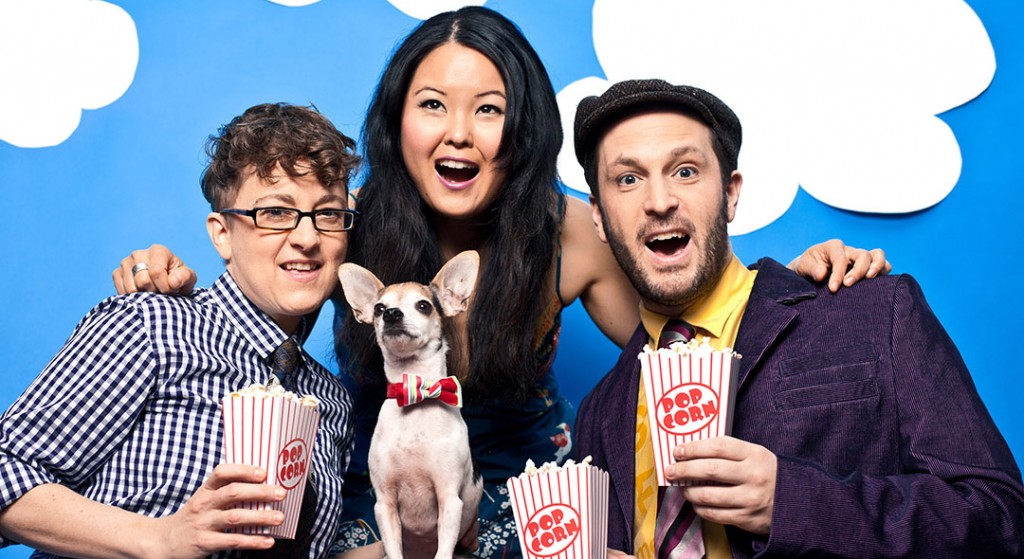
Django Jones is new to the kindie-sphere but not new in the larger world of indie music. Doris Muramatsu, JJ Jones and Nate Borofsky are former members of the band, Girlyman. While Girlyman has disbanded, these three musketeers have turned their sights toward making kids music that rocks. One of the most astounding (and outstanding) things about Django Jones is their ability to harmonize. Whether they are combining melodies or singing in counterpoint, the harmonies they deliver broaden their sound beautifully, resulting in an enormous amount of control and depth.

The idea of singing in counterpoint intrigued me because of the way it combines two or more different melodies while still allowing the song to sound whole. On their recent children’s music debut, D is for Django, the trio demonstrates this technique in their song, “Counterpoint.”

In the interview below, Doris Muramatsu talks about how Simon and Garfunkel helped her practice singing in harmony, the process that lead to the creation of the song “Counterpoint,” and how this style of singing encourages us to support and celebrate one another.

Kids Can Groove: Was your creative process different in terms of your approach to writing music for families?

Doris Muramatsu: I think there was a lot more spontaneity involved in writing music for D is for Django, primarily because there wasn’t as much self-consciousness involved. That’s the beauty of kids; They don’t judge, they don’t critique. They just gravitate toward love and joy. So we knew that as long as *we* had fun, [kids] would sense that. I think for me, personally, this was a good lesson!

KCG: I love the harmony that many of your songs have. It adds so much depth! Three-part harmonies seem to be at the essence of your sound. Was that something that evolved over time or something that just came naturally to you?

DM: Harmony was something I always gravitated towards as a child. When I was 12 or 13, I started actively singing and learning it with my best friend (Ty from Girlyman). We would learn Simon and Garfunkel songs and practice singing harmony together. There’s something magical that happens when you sing in harmony. It definitely feels spiritual to me and like you’re tapping into something greater. Im so grateful to have found people I can sing with and whose voices blend so well with mine. While it takes a lot of practice, it was something I liked to do so much that it felt natural.

KCG: How do you feel harmonic layers add to/contribute to a song?

DM: I think harmony can be used in a myriad of ways in a song. You can have one person singing a verse and then add harmony in a chorus and BOOM! Instant buildup! I think non-traditional harmonies add aural interest and make you kind of go, “Hey, what is going on there?” There’s nothing I love more than taking harmonies apart and figuring out what each person is saying. I also think lyrically, harmony can do so much. Depending on the song, for example, say you have a line that is wistful or thought-provoking. Well, you can choose harmonies that contain notes that emphasize that longing, creating even more of a feeling than just the lyrics alone. It’s just another way of bringing a song to life.

KCG: Counterpoint” addresses a specific type harmonic sound that is not typically heard in children’s music. What was the motivation behind writing a song like “Counterpoint?”

DM: I think Nate and I were wrapping up a session and started talking about how cool it would be if we could write a song demonstrating what counterpoint is in music. We were like “Yeah, so we could each sing a different part but show how those two parts fit together,” and immediately started singing lines and melodies off the top of our heads. [Nate] came up with his part and played the piano, and then I listened to the chords and made up my own melody with a different rhythm. Then we realized we could get JJ involved, too, so Nate listened to our parts together and was able to compose parts for JJ that covered your basic three-part harmony chords. The whole thing was very spontaneous and extremely inspired and fun.

KCG: What do you feel kids/adults/families can learn through techniques like counterpoint? I particularly love how the lyrics seems to encourage that while we might be singing different songs we can still work together. It seems like the lyrics can also be interpreted for how we treat each other or regard each other in friendships/relationships.

DM: That’s the great thing about harmony, it brings people together literally and figuratively. Yes, you can be singing two or three or even four different things, but you can each shine while singing your own part and make something bigger than the sum of each part! On a personal level, you can let each other be unique individuals and feel the beauty of your interactions and *support* that instead of putting it down and trying to get each other to conform. So much of our society is about conforming and there is so much individuality to be celebrated!

KCG: Do you have suggestions for how families can find ways to sing in harmony?

DM: I find the best way to sing harmony is to just do it. Get in the car, listen to a song where you can easily distinguish people’s parts, and assign those parts to your family members. At first, their only job is to stick with their part, and really concentrate on holding it steady. After several runs, then you can do it on automatic pilot, sit back and even begin to listen to the other parts going on around you! There is nothing like it.

Interview with singer/songwriter Zee Avi

A1-008

 I always say I write music that makes you feel like pancakes…Warm and cozy. – Zee Avi

Zee Avi, a 28-year-old Malaysian born singer/songwriter, has had quite a successful music career. At 21, Zee began writing songs and publishing them to YouTube for a friend. One of her songs, “No Christmas for Me,” went viral and became a YouTube feature. The video was first noticed by Patrick Keeler, drummer for The Raconteurs, which led to a signed record deal with Jack Johnson’s Brushfire Records label and a publishing deal with Monotone (White Stripes, The Shins). Throughout her career as a young singer/songwriter, Zee has produced two successful adult records, was the first Malaysian singer to be included in Starbucks’ entertainment catalog, and has received high honors and awards for her musical abilities, one of which lead to inspirational speaking engagements for young kids around the world. Zee has also played at major music festivals (Rain Forest World Music Festival, Bonnaroo, Life is Good, Lilith Fair) and will be a featured showcase presenter at this year’s family music conference, KindieComm. Quite impressive!

When I first heard Zee’s children’s debut, Nightlight(produced by Kevin Salem of Little Monster Records), I was taken by her soulful voice but also curious to learn more about her inspiration for making a children’s album. Zee was kind enough to take the time to answer some questions for me. Below we discuss an inspiring 8-year-old responsible for the adorable cover art, as well as how a karaoke machine and Joni Mitchell were childhood staples. 

Kids Can Groove: Your musical path started with a YouTube posting for a friend. Since then you have enjoyed a very successful musical career. What was your motivation behind posting a video for your first song on YouTube?

Zee Avi: I believe it’s the same then and now. It was mainly to share my stories in the form of tunes. It was also a kept secret from friends and family (besides the one friend). In a way, they were journal entries that also provided a therapeutic outlet.

KCG: At what age did you start singing and writing songs?

ZA: My real love in the art of singing began when I was very young, as I was brought up in a household where the karaoke machine was our main source of entertainment (for me, at least). Although, I began really writing songs when I was 21.

KCG: This album could easily serve as an album for adults. What was your inspiration for making a children’s album?

ZA:  The birth of this project happened quite organically. I was surrounded by people ZEE_NIGHTLIGHT_ART_FINALwho became the catalysts for this very special album to be created. The main inspiration, however, stems from the idea of preserving and rekindling one’s fond childhood
memories. The inspiration behind some of the songs are from an 8-year-old appreciator of my music, and a bright young ball of love, named Mackenzie Mauldlin. She is also the artist behind the cover art, that was a surprise for her.

KCG: How did you decide on the final song list?

ZA: The collection of songs on Nightlight are both a mix of Mackenzie’s favourites as well as mine. Joni Mitchell’s “Circle Game” was my staple lullaby to sing my little brother to sleep when he was a baby. The “Lullaby Medley” contains a group of malay folks songs my grandmother used to sing to me, and I decided on Velvet Underground’s “Who Loves the Sun” because I had to pay homage to one of the songs that led me to song write.

KCG: Nightlight is made up of cover songs. Had you thought about using some of the songs from your other albums?

ZA: My third album is currently in the works, which means there are songs that would’ve been contenders for Nightlight, however, Nightlight has such a wondrous tone and swatch within itself already and has such a bright personality that I decided to preserve that.

KCG: One of the things that I love about the album is that you stayed true to the lyrics in the songs you chose to cover. For example, The Velvet Underground’s “Who Loves the Sun” and Joni Mitchell’s “The Circle Game.” Did you second guess that at any point?

ZA: I did indeed for “Who Loves the Sun,” but as the recording went on, it felt right for it to be there. This was one of the songs that led me to realize that ‘love’ itself can be longed for in many ways. The song taught me about irony in the most gentle way, so I had to share that. As for Joni Mitchell’s “Circle Game,” it was no question. In fact, that was one song that came up first in the recording process. I love Joni Mitchell’s ideals and values. “Circle Game” brings you on a journey of growth while at the same time it teaches you that the only way is ahead, though sometimes it’s alright to look to the past in order for you to recognize your present in all blessed ways.

KCG: How would you describe your style for those who are new to your music?

ZA: I always say I write music that makes you feel like pancakes. Either it makes you want pancakes, or feel like you are one. Warm and cozy. Haha! I am such a young artist who is still learning and evolving and who knows, I might write music that makes one feel like barbecue sauce soon.

KCG: Do you have any thoughts for kids/families writing music with the intent on publishing?

ZA: I will always be a student and a learner of all my experiences, and if this experience leads me to that..why not? I will definitely give it a try!

For more on Zee Avi’s Nightlight, read the full album review here.


Guest post: Mista Cookie Jar interviews The Zing Zangs

zing zang pic

I am excited to bring you a guest post today by CJ Pizarro, aka Mista Cookie Jar. In the following post, MCJ interviews the classy cool Kindie group, The Zing Zangs. These highly ambitious teens have accomplished quite a lot in their young careers. Their positive energy shines in the following interview, which has no doubt contributed to their creative success thus far. One can’t help but wonder what’s to come.

Take it away Cookie!

The Zing Zangs — look out for this duo! These 13-year-old Canadian fellas, Trevor and Elliot, have an unstoppable amount of energy and creativity to share with the Kindie world. I interview Trevor here, who not only is the main songwriter, frontman, and Zing Zang visionary but is also a multi-instrumentalist, producer, video director, kids music internet DJ, and an all around nice kid matured WAY beyond his years. I am proud to consider him a peer even if I am 20 years his senior.

Their debut album, Blast Off!, is a 13 track banger featuring Secret Agent 23 Skidoo, Todd McHatton, Dirty Sock Funtime Band, Sugar Free Allstars, Rocknoceros, Tim Kubart of Tim and the Space Cadets, Miss Gail of Miss Gail and the Jumpin’ Jam Band, Baze and His Silly Friends, Groovy David, Jungle Gym Jam, and myself, Mista Cookie Jar.  Pretty epic for a debut I’d have to say!

Blast Off! celebrates a unique brand of freedom in songwriting from the sillier tracks such as “Moustaches” and “Vending Machines” (which is about the random stuff you’d find in a Japanese vending machine) to the touching, “From a Frown,” a sweet ode to a Teddy Bear. Raw and pure in the spirit of great indie D.I.Y. records, the dimensions of youthfulness, silliness, and wonder are all displayed clearly in the their musicality and Trevor’s careful lyrics. One is reminded of the playfulness and pop-rock sensibilities of Recess Monkey, The Aquabats, and even Weird Al Yankovic. The opportunity to pick the brain of Trevor himself made me feel like one super-curious kid talking to another as fans of the same musical scene and fans of each other.

MCJ: So what’s your story, guys? Who are you, where are you from and when did you start making family/kids music?

T: We’re two energetic 13-year-olds in Vancouver, Canada, making music for younger kids and their families! We just released our first album, Blast Off!, in October. I’m the front-leader of [The Zing Zangs], and I got into kids music when I started hosting an online kids radio station called GooberKidsRadio. The general concept for The Zing Zangs is indie pop/rock music that’s specifically made for kids to jump, sing, and dance around to. The key to it is the huge amount of imagination in each song!

MCJ: How did you first hear about and get into Kindie?

T: Sirius XM’s Kids Place Live (ch. 78) is what first got me into it. Elliot got into Kindie because he got dragged into it.

MCJ: So tell me more about the concept of Blast Off!?

T: Blast Off! released on October 2. It’s superhero themed, we go aboard the ZZ spaceship as “Commander Rock” and “Elliot the Ninja.” The key to the songs on this album is the actions. We recently played our first concert, and it was amazing to see how much energy pumps out of the kids! We’re proud to say the audience was covered in sweat! We strived to put all of that energy from a Zing Zangs’ concert into the album.

MCJ: Do you have any evil villains to go with your superhero theme?

T: I’ll tell you what – just for fun – at one of our upcoming concerts we plan on an evil monster to come and try and crash the show. Then we’ll have a rock-off. It will be so epic.

MCJ:  How did you get all these cool Kindie guests on it? Quite an impressive list. What was it like working with such talent?

T: It was an honor to work with such great people in the industry and hear our songs with different voices singing them! I was helped by excellent people in the business – like managers, publicists, live show booking management, you name it. I dreamt up “Looking Up at the Stars” last year as a finale song for an album…and to hear all of my favorite Kindie artists that I grew up listening to, singing all together at once, it was truly amazing.

MCJ: How do you guys know each other, in real life? And how did you start making songs?

T: A lot of the songs like “Moustaches” and “Vending Machines” were songs from old homemade movies we made a few years back. We drew comics all the time at school, so we often wrote theme songs for “Pizza Man,” “Kraft Dinner Man,” and “Taco Man.” We’re currently planning out a music video for an unreleased song about [me and Elliot] meeting each other on the playground as 7-year-old kids. This is actually how the two of us met in real life, so I know it will be cool to be able to make [the video], because we’ll both be behind the camera.

MCJ: It was so much fun making the track “Super Speed” with you guys. I love all the synths in the beat during my rap. And I’m happy to say I can’t get the song out of my head! The video looks great, too, especially since we haven’t met once! 

MCJ: Basically, I sent some green screen footage of myself rapping. We had me racing in a car as I did my thing. That’s me with a glass pot lid as a steering wheel! Tell us about the process from recording the song and video to working long distance with a Los Angeles artist. Also, what programs do you use?

T: It was so cool to hear your track over our synth sounds and handmade drum beat! The process to make the song involved sending you (Mista Cookie Jar) some basic keywords and lyrics for the rap – and then you sent it back to us “funktified.” That’s a word that will always be used in my personal vocab from now on.

T: “Super Speed” turned out just as we wanted it to be – a homemade-looking indie video of us chasing a cartoon monster around Elliot’s complex. Plus, as a bonus, we had you driving around in a cartoon race-car! The video made its premiere on The Cool Rockin’ Daddy Video Show. For the “Super Speed” video, I animated all of the graphics, titles, and characters with FCPX.

MCJ: Who played what instruments?

T: I played guitar, drums, keyboards, synthesizers, bass, and kazoo solos. We had occasional lead guitars by Jason Didner (of the Jungle Gym Band) and Todd McHatton. And Elliot jumped around to it.

MCJ: What is your songwriting process as a band and individually?

T: I usually come up with the idea for a song first. Then, I try to make up catchy lyrics. And then I write a chord progression that not only sounds good, but is kind of hard to play (that way I can show off when I play concerts)! Although, most of the songs on Blast Off! were written by me and Elliot when we first met.

MCJ: Tell us about your radio show, GooberKidsRadio. How did you get into that business?

T: I’ve always loved entertaining people and when I discovered Kids Place Live it made me want to host my own show…so I found a site that let me broadcast, and that was that.

T: GooberKidsRadio was created in June 2012. I’ve always had a love for entertaining people, and I had a love for Kindie, so when I found a site that let me broadcast live, I immediately started. The show picked up quite a few listeners. I just reached 11,000, I think.

T: Me being a perfectionist, I deleted all of the old episodes and restarted this year with a fresh new format, featuring new music, kid-callers, giveaways, interviews, birthday shout-outs, and characters. Now, with the busyness of The Zing Zangs, I don’t really have the time to sit back and listen to all my favorite artists anymore. So I’m not only hosting it for the listener’s enjoyment, I’m dancing and singing along as I get to hear it too. You can listen to the live broadcast every Thursday at 8pm EST/5pm PST free on GooberKidsRadio.com

MCJ: What are some of your favorite musicians, kids music or otherwise, and how has it influenced you as artists?

T: I have always been into music that doesn’t put people down or anything like that – which is why I automatically liked [Kindie music]. I grew up with The Wiggles, and when I discovered the Imagination Movers, my mind flew out of my head and into the TV. I was taken to a lot of local kids music concerts in Vancouver, like Bobs and LoLo, The Kerplunks, Fred Penner, The Doodlebops. For Kindie influences, I’d say the first few artists that I discovered in the Kindie world were Recess Monkey, Caspar Babypants, Justin Roberts and, of course, The Pop Ups. When I take my mind off of kids stuff, Elliot and I are both really into the rock genre, although I’m more of a new alternative guy like The Black Keys, They Might Be Giants, and Presidents of the United States of America (“PUSA”). Elliot is into the classics like AC/DC and Def Leppard.

T: The Aquabats actually inspired us to make our first album superhero- themed. We were both blown away by their true rock power and zaniness at the same time. That’s the definition of awesome!

MCJ:  What are your peers listening to these days?

T: Oh goodness! I think like Rihanna, Lorde, and all the other computer-generated music is big these days.

MCJ:  I love how you’re into music that doesn’t put others down. And I think the Zing Zangs go in- line with that. You guys bring a sense of empowerment that is inviting for anyone who seeks it, which is a rare and beautiful thing in this day and age. 

MCJ: In your songs there’s something else beyond the music, often a simple or quirky subject matter, like “Vending Machines” about Japanese vending machines or even, “From a Frown,” about your Teddy Bear (which is quite a touching song), that is relatable to so many people — and then the music brings a certain excitement, drama, or magic to that subject. 

T: I totally agree. That’s what being zany is about. Not ‘trying to be’ zany. Just ‘being’ it. You get it?

MCJ:  Can you speak on being in touch with your “inner zany,” if u will? How does it affect your interactions with others, like friends, peers, fans, public or otherwise? I think zaniness just helps me remember how I don’t fit in – which is PERFECT. Why would I want to be just like the guy across from me in the hallway?

MCJ: For me, being involved in a zany creative process with others, or even sharing a culture, like the Kindie, creates a bond. Having similar humor or appreciation for a certain kind of zany brings an automatic comfort with someone, without even having to “get to know” them, you feel me? 

T: Exactly.

MCJ:  You guys bring a primal joy with your music. You can call it the Zing Zang, like a zany fun Yin and Yang. But with more of a Zing of course. How bout Yin Yang Funktified? 

T: I think that’s what our next album should be called. Yin/ Yang Funktified.

What’s coming up next for The Zing Zangs?

T: Stay tuned for Mr. Runklestunk (our puppet band manager)’s very own web-series. And also coming up this year (2014), we plan to release our second CD. We’re going for a much simpler approach this year. It will not be superhero-themed but don’t worry, the silliness is all there. Original songs by “Trevor and Elliot” (not Commander and Ninja), plus a bunch of amazing special guests. It will focus more on the kids’ perspective of life, like not wanting to go to bed, and making a best friend. You can stay on top of the news at our website thezingzangs.net. Also, please check out Blast Off! on iTunes, Amazon, and CD Baby. You ca also purchase the album from our store. Thanks, Cookie!

MCJ: And here are some quickies.

T: Bring it!

MCJ: Favorite comedian?

T: Bill Cosby’s great!

MCJ: Cosby is definitely one of my favorite’s too. Favorite Weird Al album?

T: “Alpocalypse” 2011

MCJ: Heard good things about that one! Just listened to his Marc Maron interview. Al Yankovic is the man. Favorite Recess Monkey album?

T: Gosh. One of the older ones. Like “Field Trip”.

MCJ: What are you listening to right now?

T: The keys on my keyboard typing this answer. In reality, I’m listening to Zooglobble’s November playlist. Did you see that “Super Speed” got first track? Yes!

MCJ: Any books or novels on your minds?

T: Diary of a Wimpy kid. Jeff Kinney gets me. That and everything by Jarrett J Krosozcka.

MCJ: Poetry fan?

T: Shel Silverstein is inspiring.

MCJ: Feel the same way. Favorite board game?

T: Mo-No-Po-LEE!

MCJ: Favorite Cartoons?

T: MAD, Phineas and Ferb, pretty much all.

MCJ: Do u like Adventure Time?

T: Oh wait, AT is the Bomb!

MCJ: What about Avatar the Last Airbender?

T: Sorry, but there’s only one cartoon better than Adventure Time. You can’t pull me away from an episode of Regular Show.

MCJ: Do you like sketch comedy? Monty Python? Or vaudeville stuff?

T: Back around 2007 there was a small Canadian community access channel show – you know those types? The ones that probably took around $50 to create? There was this homemade sketch comedy show called “That’s So Weird” and it cracked me up.

MCJ: All time favorite album:

T: Always into the latest album that comes out by one of my favorite artists.

MCJ: All time favorite song:

T: There’s nothing better than rockin’ out to Queen’s “Bohemian Rhapsody” in your jammies.

MCJ: Agreed.

Kidquake!: The Not-Its! celebrate kid power!

276663_411718105569109_1977145708_n

I recently attended a presentation at my daughter’s school called “The Celebration of Learning.” The entire presentation was focused on young change makers, i.e. kids who are making positive change for the greater good. Each grade level (K – 5) researched, interviewed and spoke about a change maker and the outcome(s) of their efforts. It was incredible to hear these little voices talk passionately about how they were inspired by these young people. In some cases, there were kids showcasing what they are personally doing to give back, i.e. creating a petition to save a sacred Nature Area in California, hosting a bake sale to benefit the ASPCA, standing outside a homeless shelter (with mom) doling out food on cold nights, raising money to help build a school in Africa, and even raising money to name a sea turtle (“Wilson”) from Costa Rica and track another sea turtle (“Chubby”) from Bermuda who has traveled 600 miles since birth.

The Not-Its!, one of Seattle’s most popular kindie rock bands, refers to these acts of kindness as “KidQuakes.” Or, as bassist Jennie Helman describes it, “A KidQuake! describes an act of good, by a kid. It’s that seismic energy kids have that translates to dance, smiles and good times.Lead singer, Sarah Shannon continues,Kids are powerful, they have some serious mojo to make good things happen.”

When I first heard about what The Not-Its! were doing, I was blown away. As the parent of a child who is regularly disgusted by litter on the streets (and has walked around our neighborhood with a mini broom and a bag picking up garbage), I can personally attest to experiencing that serious kid mojo. The innocence and sense of justice kids have is incredible and something I have always been intrigued by. As one of the students**, age 10, put it: “I believe [kids are the ones who will make changes in this world] because children can have more open hearts. They believe in things that grown ups don’t. If you told a grown up that humans could fly, they wouldn’t believe you because of ‘course’ humans can not fly.  But if you told a young child he would think ‘could humans fly? Maybe if you…’ They would think of ideas. That is why the younger generation is going to save this world.” Kid power!

I love that The Not-Its!, one of our favorite kindie rock bands, is working hard to “showcase and inspire kids who are doing good.”

In my interview below, Sarah and Jennie talk more about the inspiration for one of 2013’s best albums, KidQuake!, what The Not-Its! are doing to highlight all of these amazing changemakers, and how you can become a part of The Not-Its! Nation!

Kids Can Groove: Can you explain the inspiration for and concept of a Kidquake?!

Sarah Shannon
: I heard this heart-wrenching story about a little girl who passed away in a car accident here in the Pacific Northwest. When she was alive, she heard that a lot of people in Africa didn’t have access to clean drinking water, so she started a fundraising drive (in lieu of birthday presents) to help build a well in Africa. After she died, her story went viral, funds started pouring in and she raised millions of dollars for clean water.

After I cried for about an hour and a half, I started to think about how amazing it was that this little girl’s spirit – her instinct to do good – was so potent that she continued to make something huge happen even after she passed.

During the time I heard this story, my band, The Not-Its!, were in the process of writing songs for our fourth record. We had a rough little gem that we were calling, “Earthquake.” Boom! The creative muses began swarming and we thought “KidQuake! Kid power for good!” We wrote the song, “KidQuake!,” but then started thinking this needs to be something more. A movement, perhaps? A way to showcase and inspire kids who are doing good.

Jennie Helman: In that moment, KidQuake! took on a whole new meaning. Kids have the power to do good and what better way to help them realize their potential than through music.

KCG: Since you started promoting this movement, have you seen or been a part of any KidQuakes?

JH: Many organizations have already established ways for kids to get involved. This summer, The Not-Its! partnered with Seattle Children’s hospital, who had already published materials on ways kids could raise money for the hospital, i.e. lemonade sales, bake sales, clothing/book drives. The Not-Its! had the opportunity to help promote a lemonade sale at a nearby elementary school, run solely by kids, where proceeds went towards the hospital. The below clip was shared on our Facebook site, which is another example of ways we have been able to promote weekly stories of Kid Power for Good on a national and local level.

KCG: Have there been any KidQuakes within your own families?

SS: I share all of the stories we showcase on Facebook with my kids. This past summer, my daughter’s CampFire troop came up with a KidQuake! of their own. Of course summer is prime lemonade stand time, and we were able to raise money for charity, as a result.

JH: Just last week my 8 year old daughter, Jaden, and I, participated in a fundraising event and 5K obstacle course in which we raised over $250 for LLS (the Leukemia and Lymphoma Society). The event was called the Winter Pineapple Express and we had to each carry a pineapple the entire route. For all our neighbors and friends who donated, we cooked soups or plates of cookies as a Thank You, depending on the amount they donated. Last year she and I did The Big Climb where we raised money towards LLS. Together, we climbed 69 flights of stairs at the tallest building in Seattle. I know that Jaden has been proud of her contributions and is starting to realize the difference she’s making with each KidQuake!. Last Christmas, all my girls spent one Saturday making art and selling it throughout the neighborhood. Their KidQuake! contributions totaled $2.88 and they were more than proud to deliver it to the local Food Bank.

KCG: Where can families participate in and read more about this movement?

SS: We are working on ways to build a social network for families to inspire/encourage each other to do good. In the meantime, we will be showcasing and inspiring families through our KidQuake and Not-Its! Facebook pages, The Not-Its!’ website and live shows.

JH: My hopes are — To generate a movement that The Not-Its! Nation – kids, parents and caretakers – feel connected to and can experience together; to appreciate kids for their acts of good and recognize how the power of kind acts can inspire kids and others towards a more positive approach in life. And, we want to showcase stories that will motivate kids and parents to do more good in their communities.

Dig what you’ve just read? Check out the song that inspired this movement, along with the the rest of the album through the Bandcamp widget below. Do you have a KidQuake! of your own? Share it in the comments below and spread the word!

**The 10-year-old student who I quoted nominated and awarded Pavan Raj Gowda who founded the organization Green Kids Now, Inc when he was 8 years old. Green Kids Now, Inc. is a 501(c)(3) nonprofit charity organization purposed to reach youth of all ages around the world to raise awareness on environmental issues, and encourages children to learn, innovate, take action, and share ideas and experiences.

Interview with Portland’s Andy Furgeson (aka Red Yarn)

Red-Yarn-with-possum-rabbit-photo-by-Aaron-Hewitt-495x400

“I approach performance as a magic act, with the ultimate goal of putting the crowd and myself in a joyful trance. When we awake from the spell, we’ve gone on a journey together that binds us as a community.”

Andy Furgeson, aka Red Yarn, is a Portland-based musician, puppeteer and teaching artist who recently released his debut children’s album, The Deep Woods.

The sound on the album is incredible, enhanced by a variety of instruments and a congregation of singers. For the production of the album, Furgeson hosted a community recording session with the help of 150 fans (as back-up singers). The result: a full-bodied folkfest filled with strings, horns, hand clapping and foot stomping.

Leading up to the production of the album, Furgeson spent 5 years researching folklore within the confines of American folk music. Ultimately, he drew inspiration from the role animals played within these folksongs, resulting in The Deep Woods. Conceptually, the Deep Woods is a magical place where all the critters featured within the album’s 12 tracks can be found.

Most of the songs, with the exception of the title track, are renditions of the originals from classic anthologies. While the songs sound upbeat, the lyrics are kept intact, illustrating the often dark interactions that take place between animals and humans. Because this is a children’s album, the many references to death and loss were surprising to me. I had a chance to interview Furgeson and upon reading his responses, my fascination with his work grew quite a bit. Read on for a more in-depth profile of Red Yarn and The Deep Woods.

Kids Can Groove: Please start by introducing yourself since this is the first time you are appearing on Kids Can Groove. Some great things to include in the intro are how you got here and some of your musical influences.

Andy Furgeson: Howdy! My name is Andy Furgeson and I perform for kids and families under the name Red Yarn. I collect American folksongs about animals and build puppets of the characters. My shows weave together music, puppetry and storytelling with the goal of bringing folklore to life for children. I grew up in Austin, Texas and have lived in Portland, Oregon for the last 8 years. Outside of the folk anthologies I dig through for material, I’m influenced by Bob Dylan, the Band, Pete Seeger, old Folkways records, and lots of modern indie, psych and folk-rock bands. I have a soft spot for Texas country and perfect pop songs.

KCG: How did you find your way into children’s music?

AF: When I moved to Portland after college in California, I was playing music for grown-ups and working with kids in an afterschool program. I wanted to combine these passions, so I began performing for families at a community center. My girlfriend, now wife Jessie and I started a kids’ band called Jelly Jar. We built a few puppets to enhance our shows and I got hooked on the energy of family audiences. When Jessie went back to school to become a middle school teacher, I created my Red Yarn persona, began performing solo, formed a puppet band, and built my skills as a teaching artist. A year and a half ago, I left my afterschool job to make this my full-time career. It’s been growing steadily ever since.

KCG: Where did the name Red Yarn evolve from?

AF: I was looking for a simple but resonant moniker that kids could remember. While playing with anagrams of Andy and Andrew I found “red” and “yarn” right there in my name. Red like my beard, fire, lifeblood, the old country singer Red Foley, all that good stuff. Yarn like the puppet material or an old folk story. The name stuck and now more kids know me as Red Yarn than as Andy. I made a fake beard out of red yarn, which I sometimes wear on top of my real beard during my performances. Don’t ask me why—it only makes me sweat more!

KCG: Your music is heavily rooted in traditional American folk music. Can you elaborate on your interest with this genre? Especially coming from a punk band in high school!

AF: I’m fascinated by the idea of the U.S.A. and how music and art have played a role in shaping our national identity. American folk music is this vibrant document of the lives of real people throughout history. To understand our country, I think it’s essential for kids to learn about our musical heritage. Growing up in Austin, I heard a lot of folk, country, bluegrass and blues music as a kid. It was a central part of my musical upbringing. In high school, I went through a rockabilly phase, then got into punk rock with my band. I discovered Bob Dylan and bought an acoustic guitar, but kept the energy of punk and early rock’n’roll. Years later and I’m hollering and banging on my guitar just as loudly, only now for kids.

KCG: You participated in the Lomax-A-Day and Song-A-Day projects. Can you talk about that a bit? It seemed to give you a deeper connection with folk music.

AF: A friend turned me onto a group called the Artclash Collective who organizes the Fun-a-Day Project every January. They challenge folks to choose a project and complete a creative act each day of the month. In 2010, I participated with Lomax-a-Day, learning, adapting, recording and writing an analysis of a folksong-a-day from Alan Lomax’s book Folk Songs of North America. I’m not that great at reading music, so part of the fun was reinterpreting each song without referencing recorded versions. It gave me a real education on folk music and inspired my Deep Woods project. It was such an invigorating experience that I decided to do it again in 2013 with Carl Sandburg’s American Songbag. That project led right into recording my album and was just the creative jumpstart I needed.

KCG: What is the Deep Woods and why is it magical? Do you feel that element plays an important part in engaging children?

AF: The Deep Woods is a magical forest where all the critters of American folksongs live together. It’s

The-Deep-Woods-album-cover-photo-by-Aaron-Hewitt-495x400magical because it exists in our imaginations and memories, and because all the critters there walk and talk and sing and dance and feel feelings just like we do. All of my shows start with a magic spell to transform the venue into the Deep Woods. The spell sets the stage and encourages the audience to experience the show with wonder and belief. With young kids the line between fantasy and reality is blurred, so I like to play in the in-between. Puppets exist in that in-between. So do animal folksongs. So does performance itself. I approach performance as a magic act, with the ultimate goal of putting the crowd and myself in a joyful trance. When we awake from the spell, we’ve gone on a journey together that binds us as a community.

KCG: Through your experience with folk music and its traditions, what drew you to exploring animals in folksongs and how do you feel they play a role?

AF: I’m drawn to animal folksongs because they’re totally weird and dark, even though they’re assumed to be kid-friendly. When I dug into the old anthologies, looking for songs I could perform for kids, I was amazed by the strange narratives and depth of emotion I found in these little ditties about animals. These songs carry profound messages about life and death, love and loss and desire, all under the guise of animal characters. I got really excited when I discovered the overlap of characters from song to song, and from songs into folktales like the Br’er Rabbit cycle. That’s when I first imagined the Deep Woods as a single place to contain all these characters and tales.

KCG: Through your research you have listened to a good number of songs from the past several centuries, can you discuss some of the songs you chose and why these songs resonated with you so strongly?

AF: First I got really interested in rabbit songs. I was reading the old Br’er Rabbit tales, fascinated by the trickster archetype. I decided to create an updated trickster character: Bob Rabbit, Br’er’s grandson. He was the first elaborate puppet I built, and “John the Rabbit,” “Mr. Rabbit,” and “Buckeye Rabbit” were among the first songs I adapted. From there, I was drawn to songs that filled the Deep Woods with more colorful characters and life-and-death narratives. “The Fox,” “Froggie Went A-Courtin,” and “Who Killed Poor Robin” all have old English roots and seemed essential, even if they’ve been recorded thousands of times before. Some songs just floored me with their poetic lyrics and plaintive melodies–“Rattlesnake” is a great example. Some lent themselves perfectly to the community singing approach–“Old Blue” and “Turkey in the Straw” wouldn’t be half as good without that crowd of singers. There are many more animal folksongs that I considered including, but ultimately this seemed like the most cohesive collection. I might have to record a sequel album… we’ll see!

KCG: The lyrics of the songs on The Deep Woods stay true to the originals which contains bits about death. While this is not completely atypical in children’s music, i.e. lullabies and nursery rhymes, it is more commonly left out. What was your thinking in preserving the balance between life and death throughout the album?

AF: I’m really glad you asked this question. Death is absolutely a central theme in The Deep Woods, just like in the real woods, just like in real life. It’s a taboo subject in our culture but it’s one of the few things we all have in common. We’re often disconnected from aging and death. Many of our grandparents live in nursing homes or across the country. There are fewer and fewer community spaces where people of all generations come together. I certainly don’t want to upset anybody, especially not kids, but I think it’s important that we talk openly about the cycles of life, including death.

In the old folksongs I sing, death is front and center. These songs have agrarian roots and were sung in settings where kids saw animals die every day. A song like “The Fox” helps a child understand why an animal would kill and eat another animal. “Mr. Rabbit” tells us that “every little soul is gonna shine,” but by the last verse the rabbit is “almost dead.” In “Froggie Went A-Courtin’,” the protagonist gets eaten at the end of a joyous celebration. “Who Killed Poor Robin?” is a straight-up funeral dirge, but it was one of the most popular nursery rhymes of all time. These songs deal with heavy stuff, but somehow the animal characters make it more digestible. Overlaid with simple narratives and human rituals, death is just another part of the story, the inevitable ending we all must reckon with.

I hope this doesn’t sound totally morbid! I am a joyful person trying to live my life to the fullest and encourage others to do the same. But only when we face our fears, like the Booger Man in “Go to Sleepy,” do we remember to cherish every moment of this precious life. I hope that my recordings and shows can be a jumping-off point for parents to have important conversations with their kids. My wife and I are expecting our first child in February, and I know that being a parent might change my whole philosophy. But, as I bring a new life into the world and grapple with these scary questions, I’ve found great comfort in the straightforward approach of folklore.

KCG: What led you to incorporate puppets into your music and performances?

AF: At first I was just looking for another way to engage kids beyond music and storytelling. But then I realized how puppets could bring these animal folksongs to life. It’s one thing for a kid to hear an old folksong like “Mr. Rabbit.” It’s something more if she can interact with that rabbit, feed him a carrot, and laugh at his tricks in real time. When animated as puppets, these characters aren’t just dusty relics of American folklore. They’re your walking, talking buddies! As my puppetry has improved I’ve discovered what a powerful tool it can be. Puppets can bring kids out of their shells, teach crucial social-emotional lessons, and be much funnier than I can be alone.

KCG: Do you create your own puppets?

AF: I build the majority of my critter puppets but I’ve also had a lot of help along the way. Portland has a thriving puppetry community, with lots of independent puppeteers and bigger companies like Tears of Joy and Laika. I’m lucky to have talented artist friends who can build puppets on commission or help when I reach the limit of my abilities. At this point, I have a repertory cast of about 20 critters who appear in my shows. They travel around with me in a suitcase and cause mischief when I’m not looking. That reminds me, I’ve been so focused on performing, recording and releasing my album that I haven’t built a new puppet in a while. Time to get back to work!

KCG: What can your audience expect from your live performances?

AF: Audiences can expect a lively show with a lot of participation through singing, dancing, stomping, clapping and interacting with the critters. I try to pour my full energy into every performance, jumping around, singing at full voice, banging on my guitar, and running my puppets all around the room. I break guitar strings all the time. And I hold the dubious honor of being Portland’s sweatiest children’s performer. That said, I try to vary the dynamics to keep kids engaged. I mix in soft, sweet songs and bring the energy down when the critters come out. Kids help Shiloh Squirrel overcome his shyness by feeding him acorns, or give hugs to Sis Goose to cheer her up. The puppets help me show my own vulnerability and empower the kids to be helpers.

When I’m lucky, I get to perform with my wife. When I’m really lucky, I perform with a full band and guest puppeteers. I’m hoping to take the show on the road this summer. I’ve done some mini-tours around Oregon, Texas, and on the east coast, but I’d love to venture further out and reach more families with these folksongs and animal characters. Holler if you know of a place for me to perform!